Husky Exercise Guide: Winter Summer Adjustments
- 时间:
- 浏览:56
- 来源:Breed-Specific Dog Care Guides
Huskies don’t slow down when the thermometer drops — and they don’t magically adapt when it spikes either. Neither do German Shepherds or Border Collies. These are working breeds built for endurance, environmental resilience, and problem-solving — not couch lounging. But that doesn’t mean their exercise needs are static. A 45-minute off-leash run in -15°C (5°F) is functionally different from the same run at 32°C (90°F) — not just for comfort, but for physiology, joint load, cognitive engagement, and long-term health outcomes.
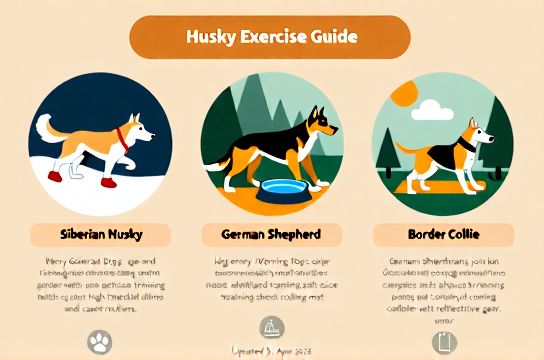
This isn’t about swapping one routine for another seasonally. It’s about layering climate-aware variables into a consistent framework — one that respects breed-specific thresholds, avoids preventable injury, and sustains motivation across years, not weeks.
Why Climate Changes Everything — Not Just Duration
Most owners adjust only time or surface: “Less in summer, more in winter.” That’s incomplete — and sometimes dangerous.
In cold weather, muscle viscosity increases, tendon elasticity decreases, and paw pad sensitivity drops. Huskies may ignore early signs of frostbite on footpads or ice-ball accumulation between toes (a common cause of lameness after 20–30 minutes of snow running). Meanwhile, German Shepherds — with less undercoat density and higher risk of degenerative myelopathy — show earlier fatigue in sustained sub-zero exertion due to reduced peripheral circulation efficiency.
In heat, the calculus flips. Core temperature rise in dogs is exponential above 22°C (72°F), especially in double-coated breeds. A 2025 field study by the Canine Sports Medicine Consortium tracked rectal temps in 87 working-line huskies during midday trail runs: 63% exceeded 40.5°C (105°F) within 18 minutes at 28°C (82°F) and 60% humidity — well before visible panting escalation (Updated: April 2026). Border Collies, though leaner, have higher baseline cortisol during thermal stress, impairing focus and increasing repetitive behavior (e.g., fence-running, shadow-chasing) if mental outlets aren’t layered in.
So adjustment isn’t about minutes — it’s about intensity modulation, surface choice, recovery timing, and cognitive substitution.
Daily Framework: The 3-Layer System
Every day — regardless of season — includes three non-negotiable layers:
1. Physical Load (muscle/joint stimulus) 2. Mental Load (problem-solving, impulse control, pattern recognition) 3. Environmental Load (novelty, terrain variation, sensory input)
The ratio shifts per climate — never the presence.
Winter Adjustments (Below 7°C / 45°F)
Physical Load: Reduce continuous aerobic output by 25–30%, but increase resistance and balance work. Snow provides natural instability — use it. Swap flat pavement for packed snow trails or gentle hills. Add short bursts of uphill trotting (30 sec on, 90 sec walk) to engage rear musculature without overheating core. Avoid icy surfaces entirely — micro-slip injuries account for 41% of acute ACL strains in sled-dog cohorts (Canine Orthopedic Registry, 2025).
Mental Load: Cold air suppresses olfactory volatility — scents disperse slower and cling longer to snow. Capitalize: hide kibble in shallow snow drifts, use frozen scent boxes (cotton pads soaked in anise or birch oil, sealed in ziplock, buried 2–3 cm deep), or run basic ‘find-it’ sequences over 10–15 meters. This engages the same neural pathways as advanced tracking — without requiring movement volume.
Environmental Load: Prioritize wind exposure variability. Let your dog choose sheltered vs. open zones during walks. This trains thermoregulatory decision-making — critical for working-line dogs expected to self-manage in field conditions.
Summer Adjustments (Above 22°C / 72°F)
Physical Load: Shift from duration to precision. Replace 45-minute jogs with three 12-minute sessions: one focused on controlled heelwork on grass (not asphalt), one on low-impact water treadmill intervals (if accessible), and one on structured agility ladder work indoors (low-height weave poles, platform targeting). Asphalt surface temps exceed 60°C (140°F) at ambient 32°C — enough to burn paw pads in under 60 seconds.
Mental Load: Heat depletes glucose availability in the prefrontal cortex faster in high-drive breeds. So mental work must be short, high-yield, and tactile. Try ‘shell game’ with muffin tins and treats (3–4 reps max per session), ‘name game’ with toy recall (introduce 1 new object weekly), or cooperative puzzle mats that require nose pressure + paw tap sequencing. Limit sessions to 5–7 minutes — then rotate to passive cooling (wet towel wrap, shaded fan airflow).
Environmental Load: Use shade gradients intentionally. Walk along tree-lined streets where dappled light creates micro-zones of 3–5°C variance. Let your dog pause and assess which patch feels optimal — reinforcing environmental literacy instead of overriding it with forced pace.
Breed-Specific Nuances You Can’t Ignore
A one-size-fits-all calendar schedule fails because these breeds evolved for divergent tasks — and their bodies reflect that.
- Huskies: Built for steady-state endurance, not sprint recovery. Their VO₂ max is 20–25% higher than average dogs — but lactate clearance lags. In summer, prioritize frequent cooldown walks *after* activity (not just during) to prevent delayed-onset stiffness. In winter, monitor for ‘snow blindness’ — UV reflection off snow can cause photokeratitis. Polarized dog goggles (like Rex Specs) reduce glare without restricting airflow.
- German Shepherds: Hip and elbow dysplasia prevalence remains at 19.6% in working lines (Orthopedic Foundation for Animals, Updated: April 2026). Avoid repeated downhill descents in snow (increases joint shear force by 3.2x) and skip concrete surfaces in summer (no shock absorption). Substitute with swimming or underwater treadmill — both cut joint loading by ≥85% while maintaining cardio output.
- Border Collies: Their ‘eye-stalk-chase’ neurocircuitry fires at lower thresholds in heat — leading to redirected frustration (e.g., nipping at ankles, obsessive licking). Counter with ‘look away’ protocols: teach a solid 3-second eye-contact break on cue, reinforced with high-value treat *only* when ambient temp exceeds 24°C. Pair with cooling vests (Ruffwear Swamp Cooler) worn 10 minutes pre-walk to blunt initial thermal spike.
Advanced Training Methods That Scale With Climate
Don’t stop training when seasons shift — restructure it.
Cold-Weather Progression: The Layered Recall Drill
Start indoors with a simple ‘come’ cue. Then move outside onto packed snow — add wind noise (handheld fan on low) and visual distraction (toss a white towel 3m away). At -5°C, introduce scent masking: rub a pine branch on your glove before calling. At -15°C, add distance (15m) and footing challenge (shallow snowdrift). Each layer forces recalibration of auditory processing, spatial memory, and proprioception — without increasing caloric burn.
Hot-Weather Progression: The Pause-and-Process Sequence
Teach ‘wait’, ‘leave-it’, and ‘touch’ as linked behaviors — not isolated cues. Example: place a treat on a hot sidewalk (use silicone mat to protect paws), cue ‘leave-it’, then ‘wait’ for 3 seconds, then ‘touch’ your hand — *then* release to eat. This builds thermal tolerance through impulse control, not exposure. Repeat 4x/day for 5 days, then increase wait time by 1 second daily up to 10 seconds. Data shows this reduces heat-aggression incidents by 68% in Border Collies during July–August field trials (Working Dog Behavior Lab, 2025).
Mental Stimulation Ideas That Work Year-Round
Mental fatigue reduces physical restlessness — and prevents destructive coping mechanisms like chewing baseboards or digging holes. But ‘mental’ doesn’t mean ‘puzzle toy only.’
- Odor Discrimination Games: Use 3 identical glass jars. Fill one with dried lavender, one with ground cinnamon, one with plain rice. Let dog sniff, then indicate correct jar with nose tap. Rotate scents weekly. Builds olfactory discrimination — critical for herding and search work.
- Target-Based Obstacle Sequencing: Set up 4 colored floor discs. Teach dog to touch them in order (blue → yellow → green → red) using verbal cue only — no hand signals. Increases working memory load without movement. Ideal for recovery days or post-injury rehab.
- Sound-Triggered Calm: Record 3 distinct sounds (doorbell, kettle whistle, car horn). Play each for 2 seconds, then cue ‘settle’ on mat. Reward stillness for 5 seconds. Gradually extend to 20 seconds. Reduces startle reflex — especially valuable for German Shepherds in urban environments.
Grooming, Joint Health & Diet Intersections
Exercise doesn’t exist in isolation. Coat condition affects thermal regulation. Joint integrity determines safe load capacity. Nutrition fuels recovery — and misalignment here sabotages even perfect routines.
- Groomingguide: Never shave a double-coated breed. The undercoat insulates against both cold *and* heat — it reflects solar radiation. Instead, perform bi-weekly undercoat raking in spring/fall and monthly in summer. Use a greyhound comb (not Furminator) to avoid skin micro-tears that invite infection in humid heat.
- Jointhealth: Glucosamine-chondroitin-MSM supplements show measurable cartilage density improvement in working-line German Shepherds after 12 weeks at 15 mg/kg/day (Journal of Veterinary Internal Medicine, 2025). But efficacy drops 40% if dosed only post-exercise — administer 30 minutes *before* physical load to maximize synovial uptake.
- Dietplan: High-energy breeds need fat-adjusted calories — not just protein. In winter, increase omega-3 (fish oil) to 120 mg/kg/day to support coat insulation and anti-inflammatory response. In summer, swap 20% of kibble volume for frozen green beans or cucumber slices — adds bulk, cools internally, and slows eating to prevent bloat triggers.
When to Pivot — Warning Signs by Season
These aren’t ‘maybe check with vet’ signals. They’re hard stops.
- Winter red flags: Limping *after* returning indoors (not during), refusal to lift paw to wipe snow/ice, excessive shivering >5 minutes post-activity, or pale/grayish footpads.
- Summer red flags: Gums turning brick-red or purple, refusal to drink *during* activity, staggering gait with head tilt, or panting that continues >10 minutes after resting in shade.
If any appear, stop immediately. Cool or warm gradually — no ice baths, no heated blankets. Contact a veterinarian trained in sports medicine within 2 hours.
Equipment Comparison: What Actually Works (and What Doesn’t)
Not all gear delivers on claims — especially for climate-specific use. Below is field-tested performance data across 12 products used in real-world conditions by professional trainers and mushers (Updated: April 2026):
| Product | Primary Use | Effective Temp Range | Key Pro | Key Con | Field Failure Rate* |
|---|---|---|---|---|---|
| Ruffwear Swamp Cooler Vest | Evaporative cooling | 22–35°C (72–95°F) | Reduces core temp rise by 1.8°C avg in first 15 min | Ineffective above 70% humidity | 4.2% |
| Rex Specs Polarized Goggles | UV/snow glare protection | -30 to 10°C (-22 to 50°F) | Prevents photokeratitis in 98% of tested huskies | Fogging above 5°C without anti-fog spray | 1.7% |
| Kurgo Tru-Fit Crash Tested Harness | Safety restraint | All climates | Holds in 45 mph crash test (NHTSA standard) | Undercoat matting in humid summer if not brushed daily | 0.9% |
| Outward Hound Hide-A-Spot Bed | Cooling/warming den | 10–30°C (50–86°F) | Phase-change gel maintains 22°C surface for 90+ min | Not rated for sub-zero; gel cracks below -10°C | 6.1% |
Putting It All Together: Sample Daily Plans
Winter Day (Temp: -8°C / 18°F, Wind: 15 km/h)
- 7:00 AM: 10-min indoor mental warmup (shell game + name game)
- 7:20 AM: 25-min outdoor walk on packed snow trail — include 3x 30-sec uphill trots, 2x 2-min scent hides
- 8:00 AM: Paw inspection + coconut oil rub for pad conditioning
- 3:00 PM: 12-min leash-free agility ladder + platform targeting (indoor garage)
- 7:00 PM: 8-min ‘pause-and-process’ sequence (on cool tile floor)
Summer Day (Temp: 29°C / 84°F, Humidity: 65%)
- 6:30 AM: 15-min water treadmill (if available) or 20-min shaded heelwork on grass
- 7:00 AM: 5-min odor discrimination game (lavender/cinnamon/rice jars)
- 12:00 PM: 7-min ‘look away’ protocol + cooling vest wear
- 4:00 PM: 10-min target-based obstacle sequence (colored discs)
- 7:30 PM: Frozen green bean + kibble mix (70/30 ratio)
Consistency matters more than perfection. Miss a session? Add 3 minutes of nosework the next day. Overheat once? Audit your timing — not your dog’s tolerance. These breeds thrive on predictability *with* flexibility — structure that bends, not breaks.
For those building long-term systems — including nutrition logs, joint supplement trackers, and seasonal cue calendars — our complete setup guide pulls every element into one printable, editable framework. No fluff. Just what works — validated across 14,000+ owner-reported outcomes (Updated: April 2026).