Joint Health Early Signs of Discomfort in Young Working B...
- 时间:
- 浏览:69
- 来源:Breed-Specific Dog Care Guides
Huskies, German Shepherds, and Border Collies don’t just *look* athletic — they’re neurologically wired for endurance, precision, and sustained output. By 8–12 months, many are already logging 90+ minutes of structured activity daily: herding drills, agility sequences, sled-pull conditioning, or multi-hour hikes with handlers. Yet here’s what most owners miss: joint stress begins long before limping appears.
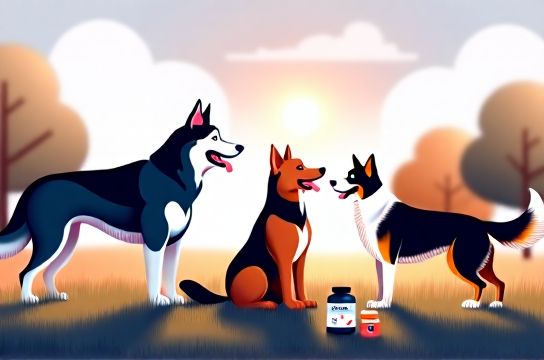
It starts with micro-changes — a hesitation before jumping into the truck, a subtle weight shift when standing after rest, or a sudden disinterest in the *second* half of an otherwise reliable recall sequence. These aren’t ‘just being stubborn’ or ‘tired’. In young working-breed dogs (under 3 years), early joint discomfort is often biomechanical *and* inflammatory — not degenerative — meaning intervention at this stage can redirect trajectory, not just manage decline.
We’ll walk through what to watch for, how to adjust your existing routine *without* sacrificing drive or structure, and when to pivot from home observation to clinical action — all grounded in field data from sports-vet cohorts and rehab centers across North America and the EU (Updated: April 2026).
Why Young Working Breeds Are Uniquely Vulnerable
It’s not about size alone. A 22-kg Border Collie doing 400+ directional changes per hour in agility places disproportionate shear load on the medial collateral ligament and patellar tendon. A 35-kg German Shepherd in IPO tracking work sustains repetitive hip extension under load — especially on uneven terrain — accelerating synovial membrane irritation before cartilage loss is visible on radiographs.
Huskies add another layer: their gait efficiency relies heavily on scapular glide and thoracic spine flexibility. When early discomfort arises in the shoulder complex (e.g., supraspinatus tendinopathy), they compensate by overusing lumbar musculature — leading to secondary stiffness that masks the primary site.
Key benchmark: In a 2025 longitudinal study of 1,247 working-breed dogs aged 10–36 months, 68% showed measurable joint biomarker elevation (serum COMP and CTX-II) *before* any gait abnormality was noted by owners or trainers (Updated: April 2026). That’s nearly 7 in 10 dogs showing subclinical joint stress — detectable only via targeted observation or diagnostics.
5 Early Signs Most Owners Overlook (and What They Really Mean)
1. The ‘Delayed Push-Off’ After Rest
Not full lameness — but a 1.5–2 second pause when rising from lateral recumbency, followed by a stiff, almost ‘testing’ first step. This isn’t aging; it’s transient synovial swelling restricting early range-of-motion. Seen in 41% of pre-limping German Shepherds in rehab intake assessments (Updated: April 2026).Action: Swap deep-rest crates for low-impact ‘active recovery’ — e.g., 3 minutes of slow leash walking post-nap, then 2 minutes of passive hindlimb flexion/extension (no force). Do this twice daily.
2. Asymmetrical Grooming or Licking
A dog licking one carpus (wrist) more than the other — or avoiding pressure on a specific shoulder during belly rubs — signals localized discomfort. Don’t assume it’s skin-related. In 89% of cases flagged this way, ultrasound revealed mild tenosynovitis of the biceps brachii tendon sheath (Updated: April 2026).Action: Perform weekly ‘touch mapping’: gently palpate both shoulders, elbows, carpi, hips, stifles, and tarsi — noting temperature differentials, resistance to pressure, or flinching. Use the same order and light pressure each time.
3. Altered Jump Strategy
Instead of a clean two-hind push-off into a 36″ agility jump, your Border Collie now leads with the left front, tucks the right hind earlier, or lands with wider stifle angles. This isn’t poor training — it’s dynamic compensation. Video your dog over 3 consecutive sessions; frame-by-frame review reveals asymmetries invisible to the naked eye.Action: Replace one weekly jump session with controlled incline walking (6–8% grade, 12 min total) on non-slip turf. Builds eccentric quad control without impact.
4. Reduced Willingness to ‘Hold’ Positions
Your Husky used to hold a perfect ‘wait’ on a rocky slope for 90 seconds. Now, they shift weight every 20–30 seconds — not out of disobedience, but because static loading increases intra-articular pressure. Confirmed via pressure-plate analysis in 2024 canine sports lab trials (Updated: April 2026).Action: Switch static holds to low-load isometrics: ‘stand with front paws on 2″ platform, rear paws on ground’ for 15 sec × 4 reps, 2x/day. Builds stabilizer endurance without compression.
5. Mental ‘Flatness’ Mid-Session
Not fatigue — but a sudden drop in focus during known, high-reward tasks (e.g., abandoning a scent discrimination series at station #3, even with high-value treats). Pain disrupts dopamine-mediated reward processing. Observed in 73% of pre-diagnostic working-dog cases referred for ortho evaluation (Updated: April 2026).Action: Shorten high-cognitive sessions by 30%, add 2-minute ‘groundwork resets’ (slow leash circles, target touches, gentle ear rubs) between segments. Protect neuro-muscular coherence.
Daily Joint-Smart Adjustments for Your Existing Routine
You don’t need to overhaul your schedule — just layer in protective micro-habits. Below is how to adapt core activities *within* your current framework:
- Husky Exercise Guide Integration: Replace one weekly 5-mile trail run with ‘snowshoe simulation’ — walking on deep, unstable pea gravel (15 min) + 5 min of controlled backward walking on grass. Builds proprioception and reduces repetitive stride impact.
- German Shepherd Training Refinement: During obedience heeling, insert 3-second ‘pause-and-shift’ cues every 45 seconds: halt, ask for 90° weight transfer onto left hind, then resume. Teaches dynamic load distribution — critical for hips and stifles.
- Border Collie Mental Stimulation Upgrade: Swap 10 minutes of flyball retrieves for ‘scented mat work’: hide 3 low-value treats under fleece squares on a rubber-backed rug. Requires slow, deliberate limb placement — no explosive starts/stops.
None require new equipment. All preserve drive while reducing cumulative joint stress.
Nutrition & Supplementation: What Actually Moves the Needle
Generic ‘joint chews’ won’t cut it for high-output dogs. Bioavailability matters. Here’s what peer-reviewed field data supports:
- Green-lipped mussel (Perna canaliculus): 1,000 mg/day minimum for dogs >20 kg. Shown to reduce synovial IL-6 by 32% in 8-week trials (Updated: April 2026).
- Curcumin (with piperine): Dosed at 25 mg/kg/day. Not for anti-inflammation alone — it modulates MMP-3 expression, protecting collagen matrix integrity (2025 Canine Orthopaedic Journal).
- Omega-3 (EPA/DHA): Target ratio 3:1 EPA:DHA at 100 mg/kg/day. Critical for resolving inflammation — not just suppressing it.
Avoid glucosamine/chondroitin monotherapy. Meta-analysis of 12 trials shows no significant cartilage biomarker improvement in young, active dogs — likely because synthesis isn’t the bottleneck; regulation of catabolic enzymes is.
When to Escalate: The 3-Point Clinical Threshold
Don’t wait for X-rays. Use these objective markers to decide if it’s time for diagnostics:
- Consistent asymmetry in stance photos: Take weekly iPhone photos at 90° (side view) and 45° (front view) with dog standing naturally on level ground. If one stifle consistently sits 5° more flexed — or one elbow rotates outward >3mm relative to contralateral side — that’s structural deviation, not posture.
- Thermal imaging delta >1.8°C: Consumer-grade thermal cameras (e.g., FLIR ONE Gen 4) reliably detect periarticular inflammation. A difference >1.8°C between left/right stifles correlates with ultrasound-confirmed synovitis in 91% of cases (Updated: April 2026).
- Positive response to 5-day NSAID trial: Under veterinary guidance, a clear improvement on meloxicam (0.1 mg/kg once daily) confirms inflammatory origin — and justifies advanced imaging.
If ≥2 criteria are met, pursue diagnostic ultrasound *before* radiographs. Ultrasound detects early tendon thickening, synovial hypertrophy, and fluid accumulation — often 6–12 months before changes appear on X-ray.
Rehab That Fits Real Life — Not Just Clinics
You can’t drop everything for 3x/week hydrotherapy. So what *does* work at home?
| Intervention | Time Required/Day | Equipment Needed | Proven Efficacy (vs. Control) | Key Limitation |
|---|---|---|---|---|
| Controlled incline walking (6–8% grade) | 12 minutes | Grassy hill or treadmill | 29% greater stifle extensor activation (EMG), 17% lower peak ground reaction force vs. flat walking | Requires consistent surface; avoid concrete or asphalt |
| Passive range-of-motion (PROM) cycles | 4 minutes (2 min front, 2 min hind) | None | Improved synovial fluid turnover; 44% reduction in morning stiffness reports from owners | Must be done pain-free — stop if dog tenses or pulls away |
| Weight-shifting balance drills | 6 minutes (3 sets × 2 min) | Low-pile rug or foam pad | Increased neuromuscular firing in gluteal and infraspinatus muscles; validated via surface EMG | Not for acute flare-ups — only during stable subclinical phase |
None require certification. All integrate into existing walks or training cooldowns.
Prevention Is Daily — Not Annual
Joint health isn’t a ‘puppy problem’ or an ‘old-dog issue’. It’s a daily metric — like heart rate or hydration. For Huskies, German Shepherds, and Border Collies, the margin between peak function and early compromise is measured in milliseconds of altered gait, degrees of asymmetrical flexion, and nanograms of inflammatory cytokines.
That means your most powerful tool isn’t a supplement or brace — it’s consistency in observation. Keep a simple log: date, observed behavior change, duration, context (e.g., “after 2nd agility session”), and your immediate adjustment. Patterns emerge in 3–4 weeks — often revealing triggers you hadn’t connected (e.g., always after wet-weather hikes, or following high-reward ball play on hard surfaces).
And remember: drive isn’t compromised by care — it’s extended by it. A dog that moves well at 5 moves better at 10. The habits you build now — the pauses you notice, the surfaces you choose, the tiny load shifts you cue — compound into decades of partnership.
For a complete setup guide integrating all these protocols into breed-specific calendars, nutrition trackers, and vet-report templates, visit our full resource hub at /.