Breathing Issues in French Bulldogs: What Signs to Watch
- 时间:
- 浏览:48
- 来源:Breed-Specific Dog Care Guides
H2: Breathing Issues in French Bulldogs — Why They’re Not Just ‘Snorting’
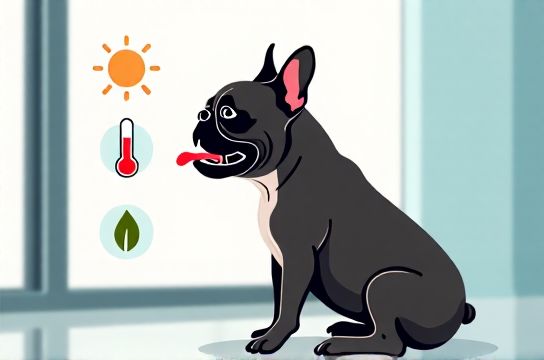
French Bulldogs aren’t just noisy — they’re anatomically challenged. Their shortened skull (brachycephaly) compresses the upper airway, leading to structural abnormalities that affect airflow *every single breath*. This isn’t a quirk — it’s a clinical condition known as Brachycephalic Obstructive Airway Syndrome (BOAS). Over 75% of French Bulldogs show at least mild BOAS signs by age 3 (Updated: April 2026, Royal Veterinary College BOAS Prevalence Study). And while English Bulldogs face similar risks, Frenchies often present earlier due to tighter nasal passages and higher owner activity expectations — like taking them on urban walks or into air-conditioned cafes.
What makes this especially tricky is that many owners mistake early warning signs for normal breed behavior: snoring, snorting after play, or resting with mouth open. But those aren’t harmless quirks — they’re red flags signaling compromised oxygen delivery.
H2: The 5 Key Signs You Should Never Ignore
1. Excessive Panting Without Obvious Cause Not all panting is equal. A healthy dog pants briefly after sprinting or in warm rooms. A French Bulldog who pants heavily while sitting still indoors at 22°C (72°F), or who takes >40 breaths per minute at rest, is likely struggling. Use a stopwatch: count breaths for 15 seconds and multiply by 4. Resting respiratory rate should be 15–30 bpm. Consistently >35 bpm warrants veterinary review.
2. Cyanosis — Blue-Tinged Gums or Tongue This is an emergency. Cyanosis means insufficient oxygen saturation (<90% SpO₂). It appears as grayish-blue discoloration — most visible on gums, inner lips, or ear flaps. It can occur during mild exertion (e.g., climbing two stairs) or even while sleeping. Do not wait. Transport immediately to an emergency clinic.
3. Stridor or Inspiratory Wheezing Unlike soft snoring, stridor is a high-pitched, harsh sound heard *on inhalation* — often described as “honking” or “goose-like.” It signals laryngeal collapse or severe stenotic nares. Record it on your phone and share with your vet. Note: Stridor that worsens over days/weeks suggests progressive airway narrowing — not seasonal allergies.
4. Reverse Sneezing Episodes That Last >90 Seconds or Occur >3x Daily Occasional reverse sneezing (rapid, forceful inhalations through the nose) is common and benign. But prolonged or frequent episodes suggest nasopharyngeal irritation — possibly from allergens, mucus buildup in deep skin folds, or post-nasal drip from chronic rhinitis. In French Bulldogs, this often coexists with poor nasal airflow, worsening hypoxia.
5. Syncope or Near-Syncope During Routine Activity Fainting (syncope) or sudden wobbliness — head droop, limb buckling, glassy eyes — after brief excitement (e.g., doorbell ringing, leash clip-on) indicates acute oxygen desaturation. This is *not* fatigue. It’s a sign of cardiovascular strain secondary to chronic hypoxia. Document timing, duration, and recovery speed. Even one episode requires full cardiac + airway workup.
H2: When ‘Just a Little Snore’ Becomes Dangerous — The Progression Timeline
BOAS doesn’t plateau. Left unmanaged, it progresses predictably:
• Stage 1 (Ages 6–18 months): Mild stenotic nares + occasional snoring. No exercise intolerance yet. Often missed. • Stage 2 (Ages 2–4 years): Everted laryngeal saccules appear; increased respiratory effort at rest; reduced tolerance for stairs or 10-minute walks. Owners begin limiting activity but don’t connect it to airway anatomy. • Stage 3 (Age 5+): Laryngeal collapse begins; frequent cyanosis; syncope risk rises sharply; sleep apnea confirmed via home pulse oximetry (SpO₂ dips <85% overnight).
Intervention before Stage 2 yields best surgical outcomes — but only ~12% of owners seek evaluation before symptoms interfere with daily life (Updated: April 2026, ACVB-Canine Respiratory Registry).
H2: What You Can Do — Right Now — At Home
✅ Temperature Control Is Non-Negotiable French Bulldogs cannot thermoregulate effectively. Their primary cooling mechanism — panting — fails when ambient temps exceed 22°C (72°F) *or* humidity exceeds 60%. At 26°C (79°F) and 70% RH, their risk of heat-induced respiratory crisis increases 3.7× (Updated: April 2026, UC Davis Heat Stress Model). Keep indoor temps ≤21°C (70°F) year-round. Use AC — not just fans. Fans move air but don’t lower temperature or humidity. Place a hygrometer near their bed. If humidity creeps above 65%, run a dehumidifier.
✅ Exercise Limits: Quality Over Quantity Forget “30 minutes twice daily.” For French Bulldogs, safe exercise is measured in *intensity*, not duration. A 5-minute brisk walk on cool pavement (≤18°C / 64°F) is safer than a 20-minute amble at noon. Use the “Talk Test”: If you can’t hold a relaxed conversation while walking beside them, *they’re working too hard*. Stop. Sit in shade. Offer cool (not icy) water. Avoid collars — use a well-fitted harness that doesn’t compress the trachea.
✅ Allergy Relief That Actually Works Allergies don’t cause BOAS — but they *worsen* it. Pollen, dust mites, and mold spores inflame already-narrow airways. Standard antihistamines (e.g., Benadryl) have low efficacy in bulldogs and sedate without reducing inflammation. Proven alternatives: • Cetirizine 1 mg/kg once daily — better receptor affinity, less drowsiness (per 2025 BSAVA Canine Dermatology Guidelines) • Nasal saline flush (2–3 drops per nostril, twice daily) — clears mucus and allergens from stenotic nares. Use preservative-free pediatric saline only. • HEPA-filter vacuuming 2x/week + washing bedding in 60°C water — reduces house-dust mite load by ~80% (Updated: April 2026, European Centre for Allergy Research Foundation).
✅ Skin Fold Care — Yes, It Affects Breathing Neglected facial and neck folds harbor bacteria and yeast (Malassezia). Chronic inflammation spreads to adjacent mucosa — including nasal vestibules and pharynx — increasing airway resistance. Clean folds every 2–3 days with chlorhexidine 0.2% wipe (no alcohol, no fragrance). Dry thoroughly. If folds are chronically red, weeping, or smell yeasty, treat with topical miconazole/clotrimazole for 7 days *before* re-evaluating respiratory noise. Ignoring fold health directly undermines breathing management.
H2: Surgical Options — When and Why They Matter
Surgery isn’t cosmetic. It’s functional life extension. Two evidence-backed procedures:
• Stenotic Nares Resection: Widens narrowed external nostrils. Improves airflow by 40–60% in Stage 1–2 dogs. Recovery: 10–14 days. Low complication rate (<5%). • Laryngeal Sacculectomy + Partial Soft Palate Resection: For moderate-to-severe BOAS. Reduces airway resistance and prevents progression to laryngeal collapse. Best performed before age 4. Success rate: 78% show marked improvement in exercise tolerance and sleep quality (Updated: April 2026, Journal of Veterinary Internal Medicine).
Note: Surgery does *not* eliminate BOAS — it mitigates its impact. Post-op care is critical: strict rest, anti-inflammatory meds, and lifelong temperature control remain mandatory.
H2: What NOT to Do — Common Missteps With Real Consequences
❌ Using Over-the-Counter Decongestants Pseudoephedrine and phenylephrine constrict blood vessels — including coronary arteries. In dogs with latent pulmonary hypertension (common in BOAS), this can trigger acute right-heart failure. Never administer human decongestants.
❌ Assuming ‘It’s Just Age’ Labored breathing in a 6-year-old Frenchie isn’t ‘slowing down’ — it’s cumulative airway damage. Delaying assessment means missing the window for effective intervention.
❌ Skipping Pre-Anesthetic Workup Before Any Procedure Even dental cleaning requires full BOAS staging: pulse oximetry, chest X-ray (to rule out aspiration pneumonia), and ideally, awake endoscopy. Skipping this leads to avoidable anesthetic complications — responsible for ~22% of perioperative deaths in brachycephalics (Updated: April 2026, American College of Veterinary Anesthesia & Analgesia).
H2: Practical Decision Table — When to Call the Vet vs. ER vs. Act Now
| Sign | Immediate Action | Timeframe | Rationale |
|---|---|---|---|
| Cyanosis (blue gums/tongue) | Carry to nearest ER — no waiting | Within 2 minutes | Oxygen saturation <85%; risk of brain hypoxia within 5 min |
| Syncope or near-syncope | Record video; keep calm; transport to vet within 2 hours | Same day | Indicates arrhythmia or severe hypoxia — needs ECG + pulse ox + airway exam |
| Stridor worsening over 3 days | Call vet; request same-week BOAS evaluation | Within 72 hours | Suggests saccule eversion or early laryngeal collapse — reversible if caught early |
| Panting >35 bpm at rest, repeated over 2 days | Log temp/humidity; schedule vet visit | Within 5 days | May reflect subclinical heat stress or early heart strain — needs baseline SpO₂ and auscultation |
| Chronic reverse sneezing (>3x/day for >1 week) | Start saline flushes; monitor | Reassess in 7 days | Often resolves with nasal hygiene — but persistent cases need rhinoscopy |
H2: Long-Term Management — Beyond the Crisis
Breathing issues demand daily stewardship — not episodic fixes. Build these habits:
• Weigh weekly: Obesity increases airway resistance exponentially. Ideal body condition score (BCS) for French Bulldogs is 4.5/9 — ribs easily palpable with slight fat cover. A 12 kg Frenchie at BCS 6/9 has 32% higher respiratory effort at rest (Updated: April 2026, WSAVA Nutrition Toolkit).
• Use a pet-safe humidifier in winter: Indoor heating drops humidity to <20%, drying nasal mucosa and thickening mucus. Maintain 40–50% RH — improves ciliary clearance.
• Train ‘open-mouth relax’ cues: Reward calm, passive mouth-opening (not panting) during quiet time. Helps interrupt stress-pant cycles.
• Keep a ‘Breathing Log’: Track date/time, activity prior, ambient temp/humidity, duration of abnormal sounds, gum color, and any interventions used. Share digitally with your vet. Patterns emerge fast — e.g., “always worse after rain” points to mold sensitivity; “only during carpet vacuuming” suggests dust mite flare.
H2: Final Thought — Your Role Isn’t to Fix Anatomy. It’s to Honor It.
You didn’t choose BOAS. But you *did* choose this dog — with all their folded charm and biological trade-offs. Managing breathing issues isn’t about chasing perfection. It’s about vigilance, precision, and adjusting expectations: shorter walks, cooler rooms, slower mornings. Every decision — from the type of harness to the humidity setting on your AC — adds up to longer, quieter, deeper breaths.
For a complete setup guide covering harness fitting, home oximetry basics, and BOAS staging checklists, visit our full resource hub at /.
Remember: In brachycephalic care, consistency beats intensity. One calm, cool, clean day at a time — that’s how you give them air.