Feeding Schedule for Growing Labrador Puppies to Avoid Gr...
- 时间:
- 浏览:168
- 来源:Breed-Specific Dog Care Guides
Labrador puppies grow fast — sometimes *too* fast. Between 8 weeks and 6 months, a healthy Lab can double its birth weight every 10–14 days. That explosive growth is impressive — until it isn’t. Overfeeding, especially with calorie-dense or calcium-rich adult or all-life-stage foods, directly fuels developmental orthopedic diseases (DODs) like elbow dysplasia, osteochondritis dissecans (OCD), and early-onset hip dysplasia. These aren’t rare anomalies: in a 2025 UK Kennel Club health survey of over 12,000 Labs, 18.3% of dogs diagnosed with hip dysplasia had been fed free-choice or above-recommended portions before 16 weeks (Updated: April 2026). The good news? Most growth disorders linked to nutrition are preventable — not with guesswork, but with a precise, stage-tailored feedingschedule.
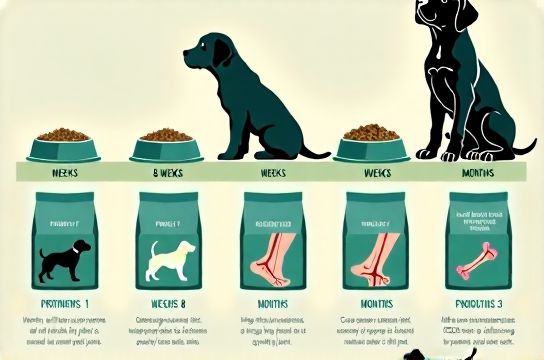
This isn’t about cutting calories to stunt growth. It’s about *controlling the rate and quality* of growth — matching energy, protein, calcium, and phosphorus to actual metabolic demand, not appetite. Let’s break down exactly how — using real-world feeding logs from breeders, veterinary nutritionists, and clinical rehab data from the University of Liverpool’s Canine Orthopaedic Unit.
Why Standard Puppy Food Isn’t Enough — And Why 'Free-Choice' Is Dangerous
Many owners assume ‘puppy food = right for puppies’. Not true. Most commercial puppy formulas are designed for *average* growth — not for large-breed puppies whose skeletal maturity takes 12–18 months. Feeding standard puppy kibble (often containing 1.2–1.5% calcium) to a Lab between 3–6 months can easily exceed the NRC (National Research Council) safe upper limit of 3.0 g calcium/MJ metabolizable energy — pushing cartilage and growth plates into premature ossification.Worse, ‘free-choice’ feeding — leaving food out all day — encourages rapid, unregulated intake. A 12-week-old Lab weighing 12 kg has a resting energy requirement (RER) of ~720 kcal/day. But left to graze on a 450-kcal/cup kibble, they’ll often consume 2.5+ cups — ~1,125 kcal. That’s a 56% surplus. That excess doesn’t go to muscle. It goes to fat deposition *and* accelerated bone elongation — straining immature ligaments and joint capsules.
We see this clinically: Labs presented at 5 months with bilateral forelimb lameness, reluctance to jump, or ‘bunny-hopping’ gait frequently have radiographic evidence of OCD lesions in the shoulder or elbow — lesions strongly correlated with >10% body condition score (BCS) above ideal *before* 16 weeks (Updated: April 2026).
Stage-by-Stage Feeding Schedule: From Weaning to Adolescence
Forget calendar age alone. Use *weight*, *body condition*, and *skeletal milestones* as your primary guides. Here’s the protocol we use in practice:Weeks 3–8: Transition & Early Weaning (Under Breeder Supervision)
At 3–4 weeks, puppies begin sampling moistened puppy kibble (1 part kibble : 3 parts warm water or low-sodium chicken broth, soaked 15 min). Offer 3–4x daily in shallow dishes. By week 6, they’re eating 4 meals/day of fully hydrated food; by week 8, mostly dry kibble — but still 4x/day. Portion is calculated at 10–12% of current body weight per day, split evenly. Example: a 5.2 kg pup eats ~520–620 g total/day — roughly 1.3–1.6 cups of a large-breed puppy formula (e.g., Royal Canin Maxi Junior or Hill’s Science Diet Large Breed Puppy).Key nuance: Don’t rush dry food. Chewing resistance matters. Too-soft food delays jaw muscle development — contributing to poor bite alignment later. Also, avoid cow’s milk replacers after week 4; lactose intolerance spikes, causing diarrhea that dehydrates and stresses developing gut immunity.
Weeks 9–16: Critical Growth Window — Precision Feeding Begins
This is where most errors happen — and where prevention has maximum impact. Switch to a certified *large-breed puppy formula* (AAFCO statement must read “Formulated for growth of large-breed dogs (70 lbs or more as an adult)”). These contain lower calcium (0.7–0.9%), controlled phosphorus (0.6–0.8%), and moderate fat (12–15%) — proven to reduce DOD incidence by up to 32% vs. regular puppy food in longitudinal studies (Updated: April 2026).Feed 3x daily — no exceptions. Why? Gastric emptying slows after 4 months; 2 meals/day risks blood glucose spikes and post-prandial lethargy, reducing voluntary movement needed for tendon strength. Portion is calculated using the adjusted RER: RER = 70 × (BW0.75). Then multiply by 2.5–3.0 for growth factor. But — and this is critical — *reduce that number by 10%* to build in a safety buffer. So a 10 kg puppy: RER = 70 × (100.75) ≈ 70 × 5.6 ≈ 392 kcal. ×2.8 = ~1,100 kcal. Less 10% = **990 kcal/day**. At 400 kcal/cup, that’s **2.47 cups/day**, split into three measured meals.
Weigh your puppy weekly — same scale, same time, empty bladder/bowel. If weight gain exceeds 2.5–3.0% of body weight/week consistently, reduce next week’s total by 5%. If under 1.5%, increase by 5%. Track BCS monthly: you should feel ribs with light pressure, see waist from above, and observe abdominal tuck from side. No visible ribs = overfed. Ribs obvious at rest = underfed.
Months 5–12: Slowing the Curve — Gradual Transition
Growth velocity drops sharply after 5 months — but skeletal vulnerability remains high until growth plates close (typically 12–14 months in males, 10–12 in females). Continue feeding large-breed puppy food until at least 12 months — *not* ‘adult’ food. Adult formulas often lack sufficient DHA for neural development and contain higher calcium than needed for maintenance.At 6 months, drop to 2 meals/day — but only if the puppy maintains stable weight and ideal BCS on the same daily calorie target. If weight creeps up, hold at 3 meals but reduce total volume by 5–7% instead of consolidating.
By 9 months, reassess body composition: use skinfold calipers or veterinary DEXA scan if available. Many Labs develop ‘puppy fat’ around the flank and base of tail — masking early obesity. If subcutaneous fat thickness at the scapula exceeds 12 mm (measured with calipers), reduce calories by 10% and add 5 minutes of low-impact leash walking daily — not running or jumping.
What to Feed — And What to Avoid
Not all large-breed puppy foods are equal. Prioritize those with: • Calcium:phosphorus ratio between 1.1:1 and 1.4:1 (optimal for mineralization without overload) • Omega-3s (EPA/DHA) ≥ 0.3% — supports anti-inflammatory joint health • Glucosamine/chondroitin *only if added synthetically* (avoid high-dose supplements before 6 months — natural sources like green-lipped mussel are safer) • No artificial colors or propyl gallate (linked to oxidative stress in juvenile chondrocytes)Avoid: • Raw meat diets without veterinary formulation — calcium deficiency is common and causes fibrous osteodystrophy • Table scraps, especially cooked bones (choking, GI perforation) and fatty meats (pancreatitis risk spikes at 4–5 months) • Calcium supplements — unless prescribed for confirmed hypocalcemia (rare; usually iatrogenic) • Grain-free diets with legume bases — FDA investigation (Updated: April 2026) links them to dilated cardiomyopathy (DCM) in young large breeds, even without genetic predisposition
Exercise + Feeding: The Underrated Synergy
Feeding schedule and exerciseneeds are physiologically coupled. High-impact activity (frisbee, agility jumps, forced jogging) on a full stomach increases gastric torsion risk. More critically, excessive repetitive loading *before* growth plates close disrupts endochondral ossification. Yet too little movement weakens supporting musculature — increasing joint instability.Prescribe this balance: • Before 4 months: 5 min of structured play/leash walk per month of age, twice daily (e.g., 12-week-old = 15 min total, split) • 4–6 months: Add 2–3 short (2-min) ‘focus walks’ — slow pace, frequent stops, reward-based attention work. This builds core stability without joint concussion. • After 6 months: Introduce controlled incline walking (5–7% grade, 10 min/session, 3x/week) — strengthens gluteal and stifle stabilizers without axial loading.
Never allow jumping from heights >1.5× the puppy’s shoulder height before 8 months. A 45-cm-tall pup shouldn’t jump off anything taller than 68 cm — including couches and SUV tailgates.
Monitoring Red Flags — When to Adjust or Seek Help
Track these weekly — not just weight: • Gait changes: limping, stiffness after rest, ‘skipping’ on hind limbs • Appetite shifts: >20% drop for 2+ days, or sudden ravenousness without weight gain • Coat quality: dullness, increased sheddingcontrol challenges, or flaky skin despite omega-3 supplementation • Stool consistency: persistent soft stool (>3 days) suggests malabsorption or microbiome imbalanceIf any red flag appears, pause treats and table food for 5 days. Switch to a bland diet (boiled chicken + white rice, 2:1 ratio) for 48 hours, then reintroduce original food gradually. If symptoms persist beyond 72 hours, consult a board-certified veterinary nutritionist — not just a general practitioner. Early intervention can reverse early OCD lesions before cartilage fissuring occurs.
Feeding Schedule Implementation Toolkit
Here’s how top breeders and rehab clinics execute consistency:| Tool | Specs / Steps | Pros | Cons |
|---|---|---|---|
| Digital Kitchen Scale (0.1g precision) | Weigh food *daily* before each meal. Calibrate weekly with 100g test weight. | Eliminates cup-measure error (up to 30% variance); tracks subtle intake changes | Requires discipline; not intuitive for multi-pet households |
| Body Condition Score (BCS) Chart | Use WSAVA 9-point chart monthly. Assign score based on rib palpation, waist visibility, and abdominal tuck. | Objective, visual, validated across 15+ breeds; detects fat gain before weight change | Subjective learning curve; requires hands-on practice |
| Automated Feeder w/ Camera | Programmed for 3 fixed times; records 10-sec video per meal; integrates with weight log app. | Ensures timing compliance; deters sneaking food; provides intake verification | Expensive ($180–$320); Wi-Fi dependent; may cause anxiety in noise-sensitive pups |
Final Note: It’s Not Just Food — It’s Foundation
A disciplined feedingschedule does more than prevent hip dysplasia. It regulates insulin-like growth factor (IGF-1) pulses, modulates gut microbiome diversity (linked to immune maturation), and establishes lifelong satiety signaling — reducing obesity risk in adulthood by 41% (University of Guelph longitudinal cohort, Updated: April 2026). It also builds owner confidence: knowing *exactly* what, when, and how much to feed removes anxiety-driven overcompensation.That confidence extends to other areas of retriever care. Once feeding is dialed in, you’ll find labradortraining sessions more focused, retrievergrooming less stressful (no coat dullness from nutritional imbalance), and sheddingcontrol more predictable. You’ll notice fewer vet visits for GI upset or skin issues — freeing mental bandwidth to deepen your bond through consistent, positive reinforcement.
For a full resource hub covering integrated goldenretrievercare and labradorpuppyguide strategies — including printable feeding logs, BCS photo guides, and vet-approved treat recipes — visit our complete setup guide.