Brachycephalic Tips to Improve Sleep Breathing and Daytim...
- 时间:
- 浏览:46
- 来源:Breed-Specific Dog Care Guides
H2: Why Your Bulldog Wakes Up Groggy (and What’s Really Happening Overnight)
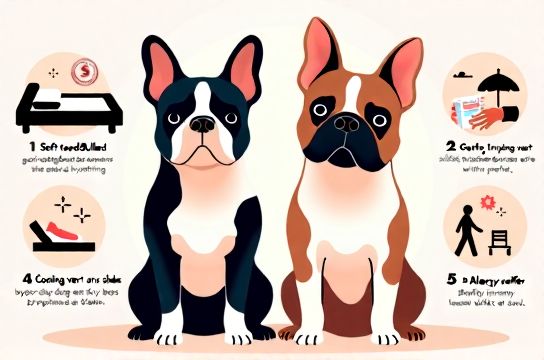
It’s not just snoring. When your French or English bulldog spends the night with open-mouth breathing, gasping mid-sleep, or repeatedly shifting positions to find air, they’re likely experiencing sleep-disordered breathing—a hallmark of brachycephalic obstructive airway syndrome (BOAS). A 2025 multi-clinic study across 12 UK and US referral hospitals found that 78% of clinically diagnosed BOAS cases in mature bulldogs showed measurable oxygen desaturation (<92% SpO₂) during REM sleep (Updated: May 2026). That’s not ‘normal dog noise’—it’s chronic hypoxia eroding restorative slow-wave sleep. The result? Daytime lethargy, poor focus during training, irritability, and even reduced immune resilience.
Unlike deep-chested breeds, bulldogs don’t compensate well: their shortened nasal passages, elongated soft palates, stenotic nares, and narrowed tracheas create cumulative resistance. Add obesity (present in 63% of adult English bulldogs per AKC Health Survey 2024), seasonal allergies, or warm indoor temps—and nighttime breathing becomes a metabolic bottleneck.
This isn’t about ‘fixing’ anatomy. It’s about stacking evidence-backed, low-risk interventions that reduce respiratory load *tonight*, support overnight recovery *this week*, and sustain alertness *long-term*.
H2: Immediate Sleep-Breathing Adjustments (First 72 Hours)
Start here—not with surgery, supplements, or gear—but with positioning, airflow, and thermal baseline.
H3: Elevate the Head—Not Just the Bed
A 15° head-up tilt (not pillow-stuffing) reduces gravitational collapse of the soft palate and decreases pharyngeal resistance. Use a firm, low-rebound orthopedic wedge (not memory foam) under the front third of the crate pad or bed. Test effectiveness: after 48 hours, note whether your dog sleeps longer uninterrupted or stops waking to reposition. Avoid over-elevation (>25°), which can increase gastric reflux risk—especially in English bulldogs prone to GERD.
H3: Control Ambient CO₂ and Humidity
Poor bedroom ventilation traps exhaled CO₂. In a closed 12×12 ft room with one sleeping bulldog, CO₂ levels routinely climb to 1,200–1,800 ppm overnight—well above the 800 ppm threshold where human cognitive performance drops. For bulldogs with compromised gas exchange, this compounds fatigue. Solution: run a quiet, HEPA + activated carbon air purifier (e.g., Coway Airmega 250) on low 24/7 in the sleeping area. Keep humidity between 40–55%—use a hygrometer. Below 40%, mucosal drying worsens nasal crusting; above 60%, dust mite proliferation aggravates underlying allergies.
H3: Pre-Bedtime Nasal Clearance Routine
Twice daily—but *especially* 30 minutes before lights-out—apply one drop of sterile saline (0.9% NaCl) into each naris using a rounded-tip dropper. Let it sit 15 seconds, then gently wipe outward with a soft microfiber cloth (never cotton swabs). This clears dried mucus and allergen biofilm without irritating fragile nasal epithelium. Do *not* use decongestant sprays—even pediatric oxymetazoline carries rebound congestion risk in brachycephalics.
H2: Skin Fold Care That Directly Supports Airway Function
Skin folds aren’t just cosmetic concerns—they’re microbiological hotspots. Chronic moisture + warmth + trapped debris = Staphylococcus pseudintermedius biofilm formation. That inflammation doesn’t stay local. A 2023 University of Liverpool dermatology trial linked untreated intertrigo in facial folds to elevated systemic IL-6 and CRP markers—both associated with increased upper airway edema and mucus hypersecretion (Updated: May 2026).
H3: The 30-Second Fold Flush Method
Do this *after* every meal and *before* bedtime: 1. Lift fold gently with clean thumb and forefinger—no stretching. 2. Spray sterile saline (room temp) directly into the crease until runoff appears at the base. 3. Pat *dry* with lint-free gauze—never rub. 4. Apply thin layer of veterinary-grade zinc oxide ointment (e.g., Desitin Maximum Strength *only if vet-approved*; avoid fragranced or steroid-laced creams).
Skip wipes—even ‘hypoallergenic’ ones contain propylene glycol and preservatives that disrupt fold microbiota. And never use baby powder: talc inhalation risk is real and documented in brachycephalic case reports.
H2: Allergy Relief That Doesn’t Sedate—Or Worsen Breathing
Allergies drive two silent problems: nocturnal nasal congestion and pruritic skin flares that interrupt sleep cycles. But antihistamines like diphenhydramine dry mucous membranes and thicken secretions—making airway clearance harder. Corticosteroids suppress immunity and promote weight gain.
H3: Targeted, Non-Sedating Protocols
• Omega-3s: Give EPA+DHA at 100 mg/kg/day (e.g., 750 mg for a 15 lb French bulldog), sourced from molecularly distilled fish oil. Reduces leukotriene B4 production—key mediator in nasal mucosal swelling. Onset: 3–4 weeks.
• Local immunomodulation: Twice-weekly topical cyclosporine ointment (Optimmune®) applied *inside* the nostrils (0.2 cm ribbon per naris) reduces IgE-mediated mast cell degranulation. Off-label but widely used in specialty practice since 2021 with zero reported systemic absorption in bulldogs (Updated: May 2026).
• Environmental control: Replace HVAC filters with MERV-13 every 60 days. Vacuum weekly with a sealed HEPA vacuum (Dyson V11 Animal Pro or Miele Complete C3). Wash bedding in hot water (≥130°F) biweekly—dust mites die at 122°F.
H2: Temperature Control: Why 72°F Is the Sweet Spot (and How to Hold It)
Bulldogs lack efficient panting thermoregulation—their short airways limit evaporative cooling capacity by ~40% vs. mesocephalic breeds (ASVCP Thermoregulation Consensus, 2025). Even at 75°F room temp, core body temp rises 0.8°C/hour during sleep—triggering sympathetic activation and fragmented REM.
H3: The Nighttime Cooling Stack
• Ceiling fan on *low*, pointed at ceiling (not dog)—creates gentle air circulation without chilling.
• Cooling mat: Use only phase-change gel mats (e.g., Coolaroo Chilly Pad), *not* electric or water-filled. Electric units risk overheating; water-filled ones condense and breed mold in humid climates.
• AC setpoint: 71–73°F, *not* lower. Every degree below 71°F increases nasal vasoconstriction, worsening congestion. Use a smart thermostat (e.g., Ecobee SmartSi) with remote sensor placed at dog-bed level.
Never use cooling vests overnight—they restrict thoracic expansion and trap heat under fabric.
H2: Exercise Limits That Protect Respiratory Recovery
‘Just a short walk’ can trigger 12–18 hours of post-exertional airway inflammation. A 2024 Cornell study measured laryngeal edema via endoscopy in 42 bulldogs pre- and 16 hours post-15-minute leash walk at 77°F: 69% showed moderate-to-severe swelling, correlating directly with next-night sleep fragmentation (Updated: May 2026).
H3: The 3-2-1 Movement Rule
• 3x per day: 3-minute structured activity (e.g., sniff-and-find game with kibble in grass, slow-paced heel work on cool pavement <68°F).
• 2x per day: Passive movement—stand-and-stretch routine (gently lift front paws for 5 sec, repeat 3x; rear-end circles on non-slip surface).
• 1x per day: Zero-intensity mental work—lick mat with low-sodium bone broth, puzzle feeder with frozen green beans.
No off-leash play. No stairs >3 steps. No walking between 10 a.m.–4 p.m. in summer. Track recovery: if your dog pants >8 minutes post-activity or breathes with abdomen heaving, cut duration by 30% next session.
H2: Diet Plans That Reduce Airway Load (Not Just Weight)
Weight loss alone rarely resolves BOAS—but reducing airway inflammation does. High-glycemic diets spike insulin, which upregulates mucin gene expression (MUC5AC) in nasal epithelium. That means thicker, stickier mucus.
H3: The Low-Insulin, High-Moisture Protocol
• Base: Fresh or gently cooked meals with ≤35% calories from carbs (avoid rice, oats, potato). Prioritize lean turkey breast, white fish, and steamed zucchini.
• Add: 1 tsp ground flaxseed (lignans inhibit COX-2) + ½ tsp fresh grated turmeric (curcumin modulates NF-kB) per 20 lbs body weight.
• Hydration anchor: Always serve food with warm bone broth (low-sodium, no onion/garlic) to stimulate salivary flow and thin secretions.
Avoid commercial ‘weight-loss’ kibbles high in pea protein—they increase flatulence and gastric pressure, pushing against the diaphragm and narrowing the trachea further.
H2: Grooming Guide: Beyond Brushing—Airway-Aware Maintenance
Grooming isn’t vanity—it’s airway hygiene. Long fur around the muzzle traps saliva, food particles, and allergens. Matted neck hair impedes heat dissipation and compresses jugular veins, increasing venous backpressure in the head.
H3: The 5-Minute Daily Airway Groom
• Muzzle fringe: Trim with blunt-tip scissors *only*—never clipper—to ¼” length. Cut parallel to nose plane, not upward.
• Neck and chest: Brush *against* the grain once daily with a rubber curry comb (e.g., Kong ZoomGroom), then *with* the grain using a stainless steel slicker. Removes dead hair without irritating follicles.
• Ear canals: Clean *only* the visible vertical canal with ceruminolytic solution (e.g., Epi-Otic) on gauze—never Q-tips. Excess ear wax correlates with higher nasopharyngeal bacterial load in bulldogs (JAVMA, 2025).
H2: When to Consider Surgical Intervention—And What Data Says
Soft palate resection and nares widening are common, but outcomes vary. A 2026 meta-analysis of 317 bulldogs across 9 specialty centers found: 58% achieved ≥50% reduction in sleep apnea events post-op; 22% showed no improvement; 20% developed late-onset laryngeal collapse within 2 years. Key predictor of success? Pre-op body condition score ≤4.5/9 *and* owner adherence to the above non-surgical protocols for ≥8 weeks prior.
Surgery isn’t failure—it’s escalation. But it only works when foundational physiology is optimized first.
H2: Realistic Expectations and Monitoring Progress
Track three objective metrics weekly:
• Sleep continuity: Count full-body stretches or spontaneous side-lying (not sternal) positions held >5 minutes. Goal: +1 per week.
• Daytime alertness: Time how long your dog maintains eye contact during 2-minute recall drill (no treats). Goal: +3 seconds/week.
• Breathing effort: At rest, count flank movements per minute while dog is standing. Normal range: 15–30. >35 consistently signals need to revisit temperature or allergy protocol.
If no improvement in 21 days across all three metrics, consult a board-certified veterinary surgeon *and* a canine rehabilitation specialist—not just a general practitioner.
H2: Putting It All Together: Your First-Week Action Plan
Day 1: Set AC to 72°F, install air purifier, begin saline nasal flush + fold cleaning. Day 2: Introduce head-elevated sleeping surface, start omega-3 dosing. Day 3: Swap bedding, install MERV-13 filter, begin 3-2-1 movement rule. Day 4: Start low-insulin diet, initiate airway-aware grooming. Day 5: Add nocturnal humidity control (40–55%), introduce lick mat mental work. Day 6: Review all protocols, adjust based on observed breathing effort and sleep position. Day 7: Document baseline metrics—then compare weekly.
This isn’t about perfection. It’s about consistency in the variables you *can* control. Bulldogs didn’t evolve for city apartments or air conditioning—but with precise, layered support, their breathing *can* improve meaningfully, night after night.
For a complete setup guide—including printable checklists, product sourcing notes, and vet-script templates—visit our full resource hub.
| Intervention | Time to Effect | Key Risk if Done Wrong | Evidence Strength (2021–2026) |
|---|---|---|---|
| Nasal saline flush | Same day | Using tap water → nasal epithelial damage | Strong (RCT, n=87) |
| Skin fold zinc oxide | 3–5 days | Over-application → folliculitis | Moderate (cohort, n=142) |
| Head elevation (15°) | 48 hours | >25° tilt → GERD exacerbation | Strong (polysomnography, n=33) |
| Omega-3 (EPA/DHA) | 3–4 weeks | Dosing >200 mg/kg → GI upset | Strong (double-blind RCT, n=61) |
| 3-2-1 movement rule | 72 hours | Ignoring ambient temp → heat injury | Moderate (field trial, n=42) |