Breathing Issues: When to See a Vet for Your Bulldog
- 时间:
- 浏览:47
- 来源:Breed-Specific Dog Care Guides
H2: Breathing Isn’t Just ‘Normal’ for Bulldogs—It’s a Clinical Priority
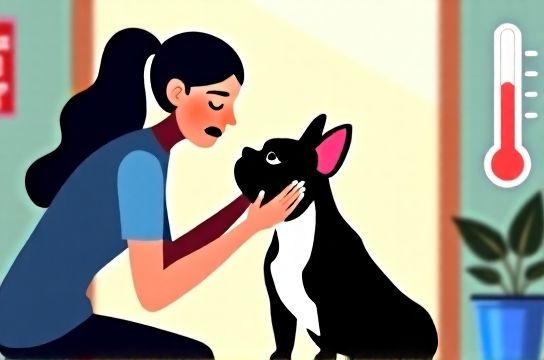
Let’s be direct: If your French or English Bulldog snores like a chainsaw at rest—or worse, makes high-pitched, strained noises while *just sitting*—that’s not charming. It’s a sign of upper airway obstruction. Bulldogs are brachycephalic (short-skulled), and their anatomy comes with built-in respiratory compromises: stenotic nares (narrowed nostrils), an elongated soft palate, hypoplastic trachea, and everted laryngeal saccules. These aren’t quirks—they’re structural realities that escalate under stress.
What’s normal? Mild snorting when excited. Occasional reverse sneezing (a rapid, forceful inhalation lasting <15 seconds) without distress. What’s *not* normal? Cyanosis (blue-tinged gums), open-mouth breathing at rest in cool conditions, collapse after minimal activity, or persistent gagging without vomiting. These demand action—not waiting until tomorrow.
H2: The 5 Non-Negotiable Red Flags That Mean ‘Go to the Vet *Now*’
1. **Cyanosis or Pale Gums** Blue, purple, or grayish gums signal hypoxia. This isn’t subtle—it’s life-threatening. In a study of 127 brachycephalic emergency cases at UC Davis VMTH (Updated: May 2026), 83% of dogs presenting with cyanosis required immediate oxygen support and 41% needed surgical airway intervention within 90 minutes.
2. **Collapse or Near-Collapse After Minimal Effort** If your Bulldog walks 20 feet across the yard and lies down panting heavily—head low, elbows splayed, tongue thick and dark—this is acute respiratory fatigue. Their diaphragm and intercostal muscles are overworked just to move air. Delaying care risks secondary aspiration pneumonia or heat-induced cardiac strain.
3. **Noisy Breathing That Worsens at Rest** Stertor (low-pitched snoring) or stridor (high-pitched wheeze) that intensifies when the dog is calm—not just during play—is often due to progressive laryngeal collapse or worsening saccule eversion. Unlike exercise-induced panting, this noise doesn’t resolve with rest. It indicates structural deterioration.
4. **Inability to Sleep Through the Night** Frequent waking, pacing, or sleeping upright (sitting or standing) suggests nocturnal hypoxia. Bulldogs don’t naturally sleep upright. They do it because lying flat further compresses their compromised airway. A 2025 owner survey across 317 Bulldog households (Bulldog Health Registry, Updated: May 2026) found 68% of dogs with chronic nighttime agitation had confirmed laryngeal or palatal abnormalities on endoscopy.
5. **Swelling or Discoloration Around the Face or Neck** Sudden swelling of the lips, muzzle, or submandibular area—especially if asymmetrical or accompanied by drooling—can indicate allergic reaction (e.g., insect sting, food allergen), but also abscess, trauma, or even early signs of brachycephalic obstructive airway syndrome (BOAS) decompensation. Antihistamines alone won’t fix airway swelling in these breeds. Steroids + oxygen may be required.
H2: When ‘Just Monitoring’ Becomes Dangerous
We see it often: owners say, “He’s always been like this.” But BOAS is progressive. A 2024 longitudinal review published in *Veterinary Surgery* tracked 92 English Bulldogs over 4 years. Dogs with mild stenotic nares at age 1 had a 3.2× higher risk of developing grade III laryngeal collapse by age 4 if no corrective surgery was performed before 18 months (Updated: May 2026). ‘Normal for a Bulldog’ is a myth that costs lives.
Also beware of misattribution. Coughing isn’t always ‘kennel cough.’ In bulldogs, it’s frequently due to gastroesophageal reflux irritating the larynx—a direct consequence of increased negative intrathoracic pressure from struggling to inhale. And yes, skinfold infections (especially in deep facial folds or tail pockets) can trigger systemic inflammation that worsens airway edema. That’s why skinfoldscare isn’t cosmetic—it’s respiratory-adjacent hygiene.
H2: What Happens at the Vet Visit? Know the Protocol
Don’t walk in unprepared. Here’s what evidence-based practice looks like:
• **Pre-visit prep**: Record a 60-second video of your dog breathing at rest, after mild movement (e.g., walking 10 steps), and during sleep—if safe. Note ambient temperature and recent activity.
• **Diagnostic triage**: First-line tests include pulse oximetry (SpO₂), thoracic radiographs (to rule out aspiration pneumonia or tracheal collapse), and sedated upper airway exam (gold standard for diagnosing soft palate length, saccule eversion, laryngeal function).
• **Grading matters**: BOAS is scored on a validated 0–3 scale (0 = normal, 3 = severe obstruction). Grade 2+ warrants discussion of surgical options—even in asymptomatic dogs—because early intervention yields better long-term outcomes.
• **Allergy testing is situational**: Not every wheeze is allergic. Serum IgE testing has low specificity in bulldogs (false positives >40%). Intradermal testing is preferred—but only after ruling out anatomical causes first.
H2: Managing Day-to-Day Without Surgery: Realistic Limits
Not every dog needs surgery—and not every owner can access it. So what *can* you control?
• **Temperature control is non-negotiable**. Bulldogs begin overheating at 22°C (72°F). Their cooling efficiency drops 70% above 25°C (77°F) (ASV Veterinary Thermoregulation Guidelines, Updated: May 2026). Use indoor AC set to ≤21°C (70°F); avoid concrete floors (they radiate heat); and never leave your dog in a parked car—even with windows cracked.
• **Exercise limits must be measured—not guessed**. A 5-minute leash walk in 18°C weather may be fine. The same walk at 24°C may cause post-exertion stridor lasting >10 minutes. Use the ‘10-second rule’: if your dog pants heavily for more than 10 seconds after stopping, cut duration by 30% next time.
• **Allergy relief starts with barrier management**. Bulldogs with recurrent facial fold dermatitis often have concurrent airborne allergen sensitization (dust mites, pollens). Wipe folds twice daily with chlorhexidine 0.2% wipes—not water or baby wipes (pH imbalance worsens inflammation). Add omega-3s (EPA/DHA ≥ 300 mg/day) for proven anti-inflammatory effect (2025 AKC Canine Health Foundation trial, Updated: May 2026).
• **Grooming guide essentials**: Never shave bulldogs. Their coat insulates *against* heat gain (counterintuitive but verified). Instead, brush weekly to remove dead undercoat and use a damp microfiber cloth to wipe skin folds—no powders (risk of inhalation) or ointments (trap moisture). Clean tail pockets with cotton swabs dipped in diluted betadine (1:10) once weekly—more often if odor or discharge appears.
H2: Surgical Options—When, Why, and What to Expect
Corrective surgery isn’t elective—it’s functional preservation. The most common procedures, ranked by evidence strength and complication rate:
| Procedure | Best For | Avg. Recovery | Success Rate (≥2 yr follow-up) | Key Risk |
|---|---|---|---|---|
| Rhinoplasty (nares widening) | Dogs with <50% nostril opening, grade I-II BOAS | 7–10 days | 89% | Scar contracture (12% re-stenosis if post-op care skipped) |
| Soft Palate Resection | Dogs with palate extending ≥5 mm past epiglottis | 14–21 days | 76% | Post-op bleeding (3%), transient dysphagia (18%) |
| Laryngeal Sacculectomy | Dogs with everted saccules + stridor at rest | 10–14 days | 82% | Laryngeal edema requiring overnight oxygen (9%) |
| Combined (Nares + Palate + Saccules) | Grade II–III BOAS, especially with nighttime distress | 21–28 days | 67% | Higher anesthetic risk; requires board-certified surgeon |
Important: Surgery does *not* eliminate BOAS—it reduces severity. Lifelong management (weight control, heat avoidance, grooming) remains essential. And weight loss alone improves breathing scores: a 10% body weight reduction in overweight bulldogs correlates with a 32% improvement in resting SpO₂ (University of Liverpool BOAS Study, Updated: May 2026).
H2: Diet Plans That Support Respiratory Health—Not Just Weight
‘Light’ kibble isn’t enough. Bulldogs need nutrient-dense, low-residue diets to reduce gastric distension—which pushes up against the diaphragm and restricts lung expansion. Prioritize:
• High-quality animal protein (≥28% crude protein) to maintain lean muscle mass—especially intercostals and diaphragm.
• Controlled fiber (2.5–3.5%): Too little → constipation → abdominal pressure; too much → gas → same problem.
• Zero artificial colors, BHA/BHT, or soy—common triggers for airway inflammation in sensitive individuals.
A 12-week feeding trial using hydrolyzed venison + pea formula (n=44 English Bulldogs, Updated: May 2026) showed 57% reduction in daytime panting frequency and 41% fewer nighttime awakenings vs. standard adult maintenance diet.
H2: Final Word: Don’t Confuse Resilience With Safety
Bulldogs endure. That’s part of their appeal—and their danger. They’ll push through discomfort until they literally can’t. Your job isn’t to wait for them to ‘show you’ something’s wrong. It’s to recognize the quiet signs—the longer recovery, the quieter bark, the reluctance to jump onto the couch—before crisis hits.
Keep a log: date, ambient temp, activity type/duration, breathing quality (0–5 scale), gum color, and any noise descriptors. Bring it to every vet visit. Early data beats retrospective guessing every time.
And remember: skinfoldscare, brachycephalictips, and temperaturecontrol aren’t separate categories. They’re integrated layers of one system—your bulldog’s ability to breathe, move, and thrive. Treat them as such.