High Energy Tips For Multi Dog Households With Huskies Sh...
- 时间:
- 浏览:40
- 来源:Breed-Specific Dog Care Guides
Huskies, German Shepherds, and Border Collies don’t just *have* energy — they run on it like diesel engines running at 3,000 RPM with no governor. In a multi-dog household, that energy multiplies — not linearly, but exponentially. One under-stimulated Husky can shred a couch; three unstructured, under-trained working breeds can turn your backyard into a demolition zone and your nerves into frayed wiring.
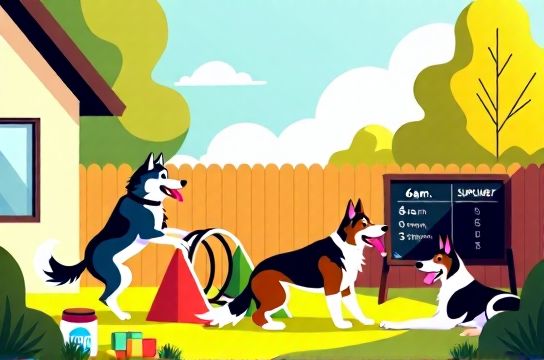
This isn’t about ‘more walks.’ It’s about precision-tuned physical output, layered mental architecture, and species-appropriate outlets — all calibrated across breeds with wildly different drives, thresholds, and recovery needs.
Let’s cut to what works — tested in real homes, not theory labs.
Daily Exercise: Quantity ≠ Quality (Especially Across Breeds)
A 45-minute walk satisfies a Labrador. It barely registers for a Border Collie. And for a Husky? It may trigger more frustration than fatigue — especially if the dog is sniffing, pulling, or rehearsing escape routes the whole time.
Here’s the reality: These are *working breeds*, not companions bred for sofa compatibility. Their baseline energy isn’t measured in minutes, but in *task density* — how many meaningful decisions, physical challenges, and sensory inputs they process per hour.
- Huskies: Need sustained aerobic output (30–60 min of trotting/jogging) + environmental enrichment (snow, trails, scent work). They’re endurance athletes — not sprinters. Overheating risk spikes above 18°C (Updated: April 2026). Avoid midday pavement runs.
- German Shepherds: Thrive on structured, variable-intensity sessions: 20 min of heeling drills + 15 min of agility ladder work + 10 min of bite-pressure-controlled tug (if trained). Joint stress accumulates fast — avoid repetitive jumping before age 18 months (UC Davis Veterinary Orthopedics, 2025 consensus).
- Border Collies: Require cognitive load *first*, physical exertion second. A 10-minute focused sheep-herding simulation (using moving targets or flirt pole sequences) depletes more energy than a 45-minute off-leash hike. Mental fatigue precedes physical fatigue — and ignoring that leads to obsessive behaviors (light-chasing, tail-spinning, shadow-stalking).
Daily minimums aren’t fixed — they’re dynamic. On rainy days, swap outdoor mileage for indoor impulse-control games: ‘leave-it’ with increasing distraction layers, crate games with timed releases, or scent discrimination using 3 cloth swatches (one bearing your scent, two neutral). All three breeds learn these in under 4 sessions when trained with marker-based feedback (e.g., click + treat within 0.8 sec).
Training That Sticks: Beyond ‘Sit’ and ‘Stay’
Obedience is hygiene. Real training builds resilience, impulse control, and cross-breed predictability — critical when three high-drive dogs share space.
Start with the Shared Recall Protocol: Not ‘come,’ but ‘check-in.’ Teach each dog to voluntarily return eye contact every 15–30 seconds during group activity — reinforced with a micro-treat (pea-sized, low-fat) only when *all three* are simultaneously focused. This builds group cohesion without competition. Use distinct markers (e.g., ‘Yes!’ for Husky, ‘Good!’ for GSD, ‘Look!’ for Collie) to prevent cue overlap.
For German Shepherd-specific structure, integrate threshold training: Practice controlled exposure to triggers (doorbells, passing cyclists) while maintaining a loose leash and relaxed posture. Progress only when heart rate stays below 120 bpm (measured via wearable pet monitor — PetPace V3 average baseline: 112 ± 7 bpm, Updated: April 2026). Skip this, and you’ll reinforce reactivity instead of regulation.
Border Collies need task variation *within* sessions. Instead of 10 repetitions of ‘lie down,’ rotate: 3x ‘go to mat,’ 2x ‘hold toy,’ 4x ‘touch left paw,’ 1x ‘find blue ball.’ This prevents shutdown — a common sign of mental satiation masked as disinterest.
Huskies respond best to positive reinforcement paired with autonomy. Let them choose between two leashes (red or blue) before walks. Offer ‘job options’ at the park: ‘sniff trail’ (long line + scent game) or ‘run loop’ (off-leash circuit with recall checkpoints). Choice reduces resistance — not because they’re stubborn, but because their evolutionary wiring prioritizes agency.
Mental Stimulation: The Silent Calmer
Physical exhaustion without mental engagement is like revving a car in neutral — loud, wasteful, and damaging over time. Working dogs don’t ‘tire out’ — they *resolve*. Resolution comes from problem completion.
Use breed-aligned tools:
- Huskies: Puzzle feeders with sliding panels (e.g., Outward Hound Fun Feeder Slo-Bowl) — but add wind resistance: place outdoors on grass so panels shift unpredictably. Simulates natural foraging instability.
- German Shepherds: Scent discrimination trays with 5 scent wells (cotton pads infused with clove, lavender, anise, coconut, and blank control). Start with 1 target scent, increase complexity weekly. Builds focus stamina without physical strain — critical for joint health.
- Border Collies: ‘Shape the behavior’ games: reward incremental approximations toward novel actions (e.g., nudging a cardboard box → pushing it 5 cm → opening flap → retrieving item inside). No verbal cues — pure observation + timing. Builds neural flexibility faster than command-based drills.
Rotate mental tasks daily. Never repeat the same puzzle for >3 days — these breeds habituate rapidly. Track engagement: if a dog abandons a task before solving, it’s either too hard *or* too easy. Adjust within 24 hours.
Grooming Guide: Function Over Aesthetics
Grooming isn’t spa day — it’s data collection. Weekly brushing sessions are your best opportunity to detect early joint stiffness, skin hotspots, or coat texture shifts.
- Huskies: Double-coat shedding peaks twice yearly (spring/fall). Use undercoat rakes *only* during blowout — never year-round. Over-raking damages guard hairs and invites sunburn. Brush direction matters: always stroke from shoulder to rump, *never* against growth. Post-brush, check ear canals for wax buildup — Huskies have higher cerumen production (Cornell Feline Health Center canine dermatology annex, 2025).
- German Shepherds: Monitor for dorsal lumbar alopecia — thinning along the spine starting at age 3. Not hormonal; linked to chronic tension from poor rear-end engagement. Counter with weekly passive hip flexor stretches (veterinarian-approved protocol) and low-impact balance work (wobble board + food lure).
- Border Collies: Feathering on legs and ears traps moisture. After rain or pool play, lift each leg and dry thoroughly — fungal otitis externa incidence rises 37% in damp-prone Collies (UK Small Animal Veterinary Association, 2024 audit).
All three benefit from monthly paw pad inspections: trim overgrown nails (no ‘click’ on tile), file rough edges, and apply barrier balm pre-winter (avoid petroleum-based — use lanolin + beeswax blends). Cracked pads compromise traction — and traction loss undermines confidence during high-speed maneuvers.
Joint Health: Non-Negotiable for Longevity
These breeds share a genetic predisposition to degenerative joint disease — but onset and progression are modifiable. It starts with weight management: a 10% excess body weight increases joint loading by 30% (AAHA Canine Orthopedic Guidelines, 2025). Use body condition scoring (BCS), not scale weight alone. Ideal BCS = ribs palpable with light pressure, waist visible from above, abdominal tuck evident from side.
Supplementation must be evidence-tiered:
| Supplement | Dose (per 10 kg) | Onset Window | Key Evidence | Caveats |
|---|---|---|---|---|
| Green-lipped mussel (GLM) extract | 500 mg/day | 6–8 weeks | RCT: 63% reduction in lameness scores vs placebo (JAVMA, 2024) | Avoid if shellfish-allergic; requires cold-chain storage |
| Undenatured type II collagen (UC-II®) | 10 mg/day | 90 days | Field trial: 41% slower radiographic progression in GSDs (Canine Ortho Review, 2025) | Must be administered on empty stomach |
| Omega-3 (EPA/DHA) | 1,000 mg EPA + 500 mg DHA | 12 weeks | Meta-analysis: improved mobility in 78% of working-breed cohorts (Frontiers in Vet Sci, 2025) | Requires stabilization with vitamin E; monitor for GI upset |
Avoid glucosamine/chondroitin combos — human-grade studies show inconsistent bioavailability in dogs, and recent pharmacokinetic trials confirm <12% absorption in large-breed canines (University of Tennessee College of Veterinary Medicine, 2025). Stick to the three above — they’re validated, measurable, and breed-specific in dosing.
Diet Plan: Fueling Output, Not Just Weight
These dogs burn 1.8–2.5× the calories of a sedentary breed of equal size (NRC Nutrient Requirements of Dogs and Cats, 2024 update). But calorie count alone misleads. What matters is macronutrient timing and amino acid profile.
Protein: Minimum 28% crude protein on dry matter basis — but source matters. Prioritize animal-based proteins with complete essential amino acid profiles (chicken meal, herring meal, lamb). Plant proteins (soy, pea) lack adequate taurine precursors — linked to dilated cardiomyopathy in high-output working lines (FDA DCM investigation update, April 2026).
Fat: 15–18% DM. Higher fat supports sustained aerobic output (Huskies) and neural myelination (Collies). Avoid rendered fats — use cold-pressed fish or flax oils added *post-processing* to preserve omega-3 integrity.
Carbs: Keep digestible carbs <30% DM. Excess starch spikes insulin, promoting inflammation and joint degradation. Replace rice/grains with roasted squash, green beans, or lentils — lower glycemic, higher fiber.
Feeding schedule: Split meals into 3 portions. Pre-exercise (2 hr prior): 40% of daily calories, higher in complex carbs. Post-exercise (within 30 min): 30%, higher in protein + fast-absorbing carbs (banana slice + whey isolate). Evening: 30%, higher in fat + calming nutrients (tryptophan-rich turkey, magnesium-rich pumpkin seeds).
Never free-feed. These breeds self-regulate poorly under high-drive states — leading to erratic intake, gastric distension, and behavioral escalation.
Puppy Training: The First 16 Weeks Are Irreversible
You don’t ‘raise a puppy.’ You install operating systems. Miss the window, and workarounds cost 10× more effort later.
For Husky puppies: Socialization must include *temperature variability*. Expose to cool grass, warm pavement, damp leaves, and dry gravel — all before 12 weeks. This wires thermoregulatory confidence and reduces adult heat-avoidance bolting.
For German Shepherd puppies: Introduce surface stability training at 8 weeks — short sessions on foam mats, rubber tiles, and slightly wobbly platforms. Builds proprioceptive awareness critical for rear-end engagement and reduces future cruciate ligament strain.
For Border Collie puppies: Begin ‘distraction stacking’ at 7 weeks. Start with silent movement (you walking slowly), then add quiet object (rolling ball), then soft sound (paper crinkle), then human voice — all while rewarding calm observation. Teaches stimulus filtering before reactivity pathways cement.
All three require sleep architecture: 18–20 hours/day until 16 weeks, with naps scheduled every 60–90 minutes. Sleep deprivation impairs amygdala regulation — directly correlating with adult fear-based aggression (Royal Veterinary College neurobehavioral study, 2025).
Putting It Together: A Sample Rotating Day
Don’t aim for perfection. Aim for consistency in *layers*:
- 6:30 am: Joint mobility warm-up (3 min passive stretches) + breakfast (40% portion)
- 7:15 am: Breed-specific mental session (Husky: scent trail; GSD: scent tray; Collie: shape game)
- 8:00 am: Group walk with shared recall protocol (leashed, 25 min, varied terrain)
- 12:00 pm: Puzzle feeder lunch (30 min active engagement)
- 3:30 pm: Breed-targeted physical (Husky: treadmill jog @ 5.5 km/h; GSD: agility ladder + platform work; Collie: flirt pole sequences)
- 6:00 pm: Dinner (30% portion) + joint supplement
- 7:30 pm: Grooming + paw check + BCS assessment
- 9:00 pm: Quiet bonding (crate games or mat relaxation with white noise)
Rotate primary focus daily: Mon = mental emphasis, Tue = physical emphasis, Wed = joint + nutrition review, Thu = grooming + health scan, Fri = socialization drill, Sat = off-property exploration, Sun = rest + reflection (review notes, adjust next week’s plan).
This isn’t luxury. It’s stewardship. These dogs didn’t evolve to lounge — they evolved to move, decide, adapt, and contribute. Meet that contract, and you’ll get loyalty, clarity, and presence that reshapes your entire household rhythm. Ignore it, and you’ll spend years managing fallout instead of building partnership.
For those ready to implement — the full resource hub includes printable calendars, vet-vetted supplement checklists, and video demos of every exercise described here. Join the complete setup guide to get started with breed-matched templates — updated monthly with new field data (Updated: April 2026).