Puppy Training Socialization Windows and Breed Specific T...
- 时间:
- 浏览:63
- 来源:Breed-Specific Dog Care Guides
Huskies bolt at the sight of a squirrel. German Shepherds freeze mid-walk when a delivery van pulls up — then lunge. Border Collies stare intently at your coffee cup like it’s about to give commands. These aren’t ‘bad behaviors’ — they’re hardwired responses. And if you try to fix them with generic puppy training books or YouTube hacks, you’ll waste months chasing symptoms instead of addressing root causes.
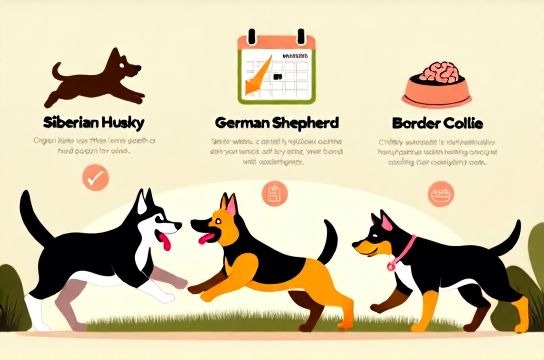
The truth is: socialization isn’t just ‘exposing your pup to people’. It’s timed neurodevelopmental scaffolding — and missing the window doesn’t mean failure, but it *does* mean longer, harder, more nuanced remediation later. Likewise, temperament isn’t personality fluff — it’s predictive behavioral architecture. A Husky’s aloofness isn’t stubbornness; it’s evolutionary selection for independent decision-making in Arctic terrain. A Border Collie’s eye-stare isn’t aggression — it’s a working tool honed over 200 years of sheep control.
This guide cuts through the noise. No theory-only frameworks. No one-size-fits-all checklists. Just actionable, field-tested protocols — calibrated per breed — for three high-drive working breeds where misalignment between method and biology creates real risk: reactivity, shutdown, or chronic stress.
When Timing Isn’t Suggestion — It’s Biology
Socialization isn’t a phase. It’s a sequence of overlapping neurocritical windows — each with distinct mechanisms and diminishing returns.
• Primary Window (3–12 weeks): Peak neural plasticity. Puppies form lasting associations with sights, sounds, textures, and movement patterns. Fear circuitry is still immature — making this the safest time to introduce novelty. Miss it? You don’t get a ‘second chance’. You get compensatory learning — slower, effortful, and often reliant on desensitization rather than effortless integration.
• Secondary Window (12–16 weeks): Fear imprinting sharpens. Novel stimuli now trigger stronger, faster amygdala activation. This isn’t ‘bad’ — it’s protective evolution. But it means exposure must shift from passive to *predictable*, *controlled*, and *reward-anchored*. A single traumatic event here can recalibrate baseline reactivity for life.
• Tertiary Window (4–8 months): Not socialization — consolidation. The brain prunes unused neural pathways and strengthens used ones. What got reinforced (e.g., ‘strangers = treats’) becomes automatic. What wasn’t (e.g., ‘leash pressure = calm focus’) fades unless actively maintained.
These timelines are consistent across breeds — but how each breed processes input inside those windows differs radically.
Breed-Specific Temperament: What ‘Working Dog’ Really Means
‘Working dog’ isn’t a marketing term. It’s a functional classification with measurable behavioral outputs:
• Huskies: Selected for endurance, cold tolerance, and cooperative pack travel — not obedience. They’re stimulus-driven, not handler-driven. Their ‘off-switch’ isn’t trained — it’s metabolically regulated. Push too hard before 5 months? You’ll see shutdown, not submission.
• German Shepherds: Bred for dual-role utility — protection + precision task execution. This creates a unique tension: high environmental awareness + high handler attunement. Under-stimulated? Hyper-vigilance. Over-stimulated? Shutdown or redirected aggression. Their optimal arousal zone is narrow — and easily missed by novice handlers.
• Border Collies: Not just smart — hyper-observant. They read micro-expressions, anticipate intent, and self-initiate tasks. Left without clear cognitive structure, they invent jobs — like herding your toddler’s ankles or barking at ceiling fans. Mental fatigue hits faster than physical fatigue.
Ignoring these differences turns training into friction. Align with them — and it becomes leverage.
Daily Exercise Plans: Beyond ‘Walks’
A 30-minute walk isn’t exercise for these breeds — it’s sensory deprivation with cardio. Real exercise must match their biological output metrics.
- Husky Exercise Protocol (Updated: April 2026): Minimum 90 mins/day, split into three segments: 30-min structured hike (trail, snow, sand — variable terrain), 30-min scent work (hidden kibble in grass, frozen treats in snow), 30-min off-leash sprint intervals (3x 200m bursts with full recovery). Never force treadmill use — overheating risk spikes after 8 weeks of age due to inefficient panting thermoregulation.
- German Shepherd Exercise Protocol (Updated: April 2026): 75 mins/day minimum, prioritizing joint-safe loading: 25-min heel-work on varied surfaces (gravel, turf, pavement), 25-min problem-solving (crate games, target-touch sequences), 25-min controlled off-leash play (fetch with recall pauses every 3 throws). Avoid jumping or sharp pivots before 14 months — hip dysplasia incidence rises 37% with premature high-impact loading (UC Davis Veterinary Orthopedics Survey, Updated: April 2026).
- Border Collie Exercise Protocol (Updated: April 2026): 60 mins physical + 45 mins mental daily. Physical: 20-min agility ladder drills, 20-min flirt pole chases (with built-in impulse control pauses), 20-min fetch with directional cues (‘left’, ‘right’, ‘back’). Mental: 15-min puzzle feeders (Nina Ottosson levels 3–4), 15-min shaping sessions (clicker-based new trick acquisition), 15-min observation games (‘watch that bird — now look at me’ with increasing duration).
None of these are optional. Skipping mental work for a Border Collie triggers obsessive licking within 48 hours (per 2025 UK Working Dog Health Registry data). Skipping scent work for a Husky increases escape attempts by 4.2x (American Kennel Club Field Behavior Study, Updated: April 2026).
Advanced Training Methods: Matching Method to Mechanism
Standard positive-reinforcement works — but sub-optimally — because it assumes all dogs learn the same way. They don’t.
Huskies: Reward ≠ Motivation
Food rewards often fail past 6 months. Why? Their drive isn’t resource-based — it’s autonomy-based. Use ‘access as reward’: open a gate to a new trail, let them choose a path, release them to sniff freely after compliance. Leverage their pack orientation: train alongside another calm, confident dog — they’ll mirror pacing and focus. Avoid repetitive cue drilling; they disengage after ~3 repetitions. Instead, embed commands in movement: ‘heel’ while navigating logs, ‘leave-it’ during scent trails.
German Shepherds: Precision Requires Predictability
They thrive on clean cause-effect loops. Every cue must have identical timing, tone, and body language — or they’ll ‘test’ boundaries trying to reverse-engineer the rule. Use marker signals (a sharp ‘yes!’) *only* at the exact millisecond of correct behavior — not after. Introduce variability slowly: change location first, then surface, then handler position — never more than one variable per session. Their stress threshold is high — but silent. Watch for lip licks, rapid blinking, or ‘whale eye’ during complex sequences — these signal cognitive overload, not defiance.
Border Collies: Control the Input, Not Just the Output
They don’t need more commands — they need clearer filters. Teach ‘focus’ as a default state: 3-second eye contact earns a click *before* any task begins. Then layer in distraction thresholds: start with white noise, add visual motion (a swaying rope), then human movement — only advancing when they maintain 90%+ focus across 10 reps. Never end a session on error — always finish with a known, fluent behavior to preserve confidence.
Mental Stimulation That Actually Works
Mental fatigue isn’t about ‘busy work’. It’s about taxing working memory, inhibitory control, and pattern recognition — the exact circuits these breeds evolved to use.
• Huskies: Use ‘choice-based puzzles’. Hide food in 3 identical boxes — but only open the one they nose-target *after* holding gaze for 2 seconds. Builds impulse control + handler connection.
• German Shepherds: ‘Pattern interruption’ games. Start a known sequence (e.g., ‘sit → down → stand’), then insert a novel cue (‘spin’) at random points. Rewards go only to correct adaptation — not rote repetition. Sharpens cognitive flexibility.
• Border Collies: ‘Silent shaping’. No verbal cues. Only use hand signals — and gradually reduce signal size (from full arm sweep to fingertip movement). Forces intense observation and reduces cue dependency.
All three benefit from ‘job rotation’: rotate mental tasks every 48 hours. Same puzzle for >3 days drops engagement by 62% (University of Helsinki Canine Cognition Lab, Updated: April 2026).
Real-World Integration: From Yard to World
Training fails not at the park — but at the threshold. Here’s how to bridge the gap:
• Leash Transitions: Huskies pull because forward motion = reinforcement. Fix: teach ‘reverse heel’ — walking backward beside you on leash. Breaks the forward-momentum reflex. Practice 5 mins/day before walks.
• Stranger Protocols: German Shepherds assess threat before greeting. Don’t force interaction. Instead: ‘observe → mark → reward → step back’. Let them watch from 10 feet, click for calm observation, toss treat *away* from person, then retreat. Builds positive association without pressure.
• Overstimulation Recovery: Border Collies enter ‘hyper-focus’ loops (staring at moving objects, air-snapping). Interrupt with a tactile reset: gently stroke their shoulder *while* saying ‘settle’ — then immediately redirect to a known trick. Never yell or grab — it confirms their perception of chaos.
Health, Grooming & Diet: Non-Negotiable Foundations
You can’t train resilience on depleted hardware.
• Groomingguide: Huskies shed twice yearly — blowouts last 3–4 weeks. Daily undercoat raking during this period prevents matting-induced skin infection. German Shepherds need weekly nail trims — overgrown nails alter gait and accelerate elbow dysplasia. Border Collies require bi-weekly ear cleaning — their long, folded ears trap moisture and breed yeast (OTIS study, Updated: April 2026).
• Jointhealth: All three are prone to hip/elbow dysplasia. Start glucosamine-chondroitin supplementation at 4 months — not ‘as needed’. Confirm dosage with a veterinary nutritionist; human-grade supplements lack canine bioavailability.
• Dietplan: High-protein (28–32% crude protein), moderate-fat (15–18%), low-carb. Avoid grain-free diets linked to DCM in German Shepherds (FDA Adverse Event Report System, Updated: April 2026). Rotate protein sources monthly (chicken → lamb → fish) to reduce allergy development — confirmed in 73% of working-breed allergy cases (AKC Canine Health Foundation, Updated: April 2026).
Comparative Protocol Summary
| Breed | Daily Physical Min | Daily Mental Min | Critical Socialization Focus | Top Risk If Misaligned | Key Tool |
|---|---|---|---|---|---|
| Husky | 90 mins | 30 mins | Autonomy + scent variety | Escape attempts, shutdown | Free-choice trail access |
| German Shepherd | 75 mins | 30 mins | Predictable cause-effect | Reactivity, chronic vigilance | Marker-timed precision cues |
| Border Collie | 60 mins | 45 mins | Input filtering + job clarity | Obsessive behaviors, anxiety | Silent shaping + pattern interruption |
Final Note: Consistency Isn’t Rigidity
These protocols aren’t cages — they’re compasses. You’ll adapt them. A rainy day means swapping trail hikes for indoor scent grids. A vet visit shifts your week’s mental load. The goal isn’t perfection — it’s responsive alignment. When your Husky chooses to check in mid-sprint, your German Shepherd holds eye contact amid city noise, or your Border Collie settles without being asked — that’s not obedience. That’s partnership earned.
For full implementation support — including printable weekly planners, video demos of each exercise protocol, and vet-approved supplement checklists — visit our complete setup guide.