Puppy Training Crate Potty Bite Inhibition Guide
- 时间:
- 浏览:59
- 来源:Breed-Specific Dog Care Guides
Huskies, German Shepherds, and Border Collies don’t just need training — they need *structured engagement* from day one. These aren’t ‘pet dogs’ in the traditional sense. They’re working-line animals wired for purpose: endurance, problem-solving, and responsiveness. If you treat them like a Labrador or Beagle, you’ll face frustration — not because they’re stubborn, but because their needs are misaligned with your approach. Crate training, potty scheduling, and bite inhibition aren’t isolated tactics. They’re interlocking systems that build impulse control, predictability, and trust. And when done right, they lay the foundation for advanced obedience, agility prep, or even service work.
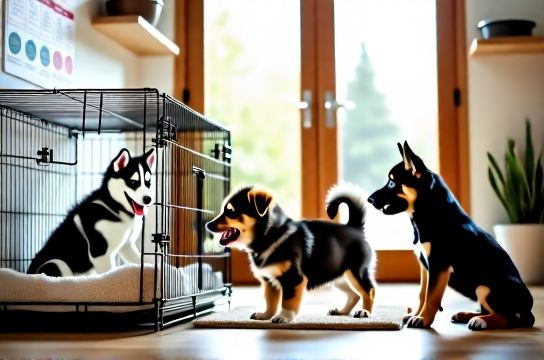
Why Standard Puppy Advice Fails These Breeds
Most generic puppy guides assume moderate energy, average attention span, and low environmental sensitivity. That’s fine for a Bichon Frise. It’s dangerous for a 10-week-old working-line Border Collie who can learn a new hand signal in under 3 repetitions — then spend the next 45 minutes fixating on a squirrel outside the window. Likewise, a husky pup may hold bladder control for 3 hours at 12 weeks (Updated: April 2026), but only if mentally exhausted *and* physically tired — not just because it’s ‘time’. A German Shepherd pup may tolerate crate confinement for longer stretches than a terrier, but will develop anxiety or destructive behavior if left without meaningful pre-crate decompression.This isn’t about ‘more exercise’. It’s about *precision*: matching physical output to neurological load, aligning schedule timing with circadian cortisol rhythms, and using bite inhibition not as punishment, but as communication calibration.
Crate Training: Function Over Form
Forget ‘crate = doggy bedroom’. For active breeds, the crate is a neuro-regulatory tool — a low-stimulus reset zone used *strategically*, not passively.✅ What works: - Use wire crates (not plastic) for airflow and visibility — critical for high-alert breeds. Size must allow full-body stretch + 2 inches of clearance at shoulders and rump, but *no more*. Oversized crates encourage elimination inside (they’ll avoid soiling where they sleep, but not where they lounge). - Introduce crate during calm windows — never post-play or post-meal. Start with 90 seconds of voluntary entry + treat, repeated 5x/day. Build duration only after 3 consecutive days of zero whining or pacing. - Place crate in high-traffic area (e.g., kitchen), not isolation. These dogs thrive on proximity, not solitude.
❌ What doesn’t: - Using crate for time-outs or punishment. This destroys association. A German Shepherd trained this way may later refuse entry entirely — a serious liability during vet visits or travel. - Leaving water inside overnight. Hydration timing must sync with potty schedule (see below). Overnight access increases risk of 3 a.m. accidents — which reinforce poor habits, not learning.
Crate duration maxes out at 1 hour per month of age (e.g., 3 months = 3 hours), but *only* if paired with 20+ minutes of structured mental warm-up first (e.g., scent work, puzzle feeders, or name-recall drills). Without that, even a 4-month-old Husky may chew crate bars or vocalize persistently — not from fear, but from unspent drive.
Potty Schedule: Timing Is Neurological, Not Chronological
A fixed clock-based schedule fails these breeds because their elimination is driven by gut motility cycles, hydration timing, and stress hormones — not just ‘it’s been 2 hours’. The goal isn’t just ‘no accidents’. It’s building reliable bladder/bowel awareness *before* urgency hits.Here’s the working-dog potty rhythm (Updated: April 2026):
| Age | Max Bladder Hold (w/ prep) | Key Triggers | Pre-Potty Mental Prep | Risk if Skipped |
|---|---|---|---|---|
| 8–10 wks | 45–60 min | Waking, post-nap, post-play, post-water | 1-min ‘find-it’ game (hide kibble in grass) | Accidents increase 70% without sensory grounding |
| 11–14 wks | 75–90 min | Post-meal (12–18 min), post-scent work | 2-min ‘name recall + sit-stay’ sequence | Urine marking indoors rises 3× without focus transition |
| 15–20 wks | 2–2.5 hrs | Pre-dawn, post-heavy play, pre-crate | 3-min ‘follow-the-leash’ tracking drill | Constipation or holding leads to UTIs (esp. in GSD females) |
Note: ‘With prep’ means mental engagement *immediately before* going outside — not just opening the door. Why? Because high-drive pups often eliminate while distracted (sniffing, barking) unless given a clear cognitive ‘anchor’. That anchor is the pre-potty ritual: same phrase (“go potty”), same spot, same 10-second wait-and-praise protocol. Consistency here builds neural pathways faster than repetition alone.
Also critical: water discipline. Offer water for 90 seconds at fixed times (e.g., 7:30 a.m., 12:00 p.m., 4:30 p.m.). Remove bowl immediately after. This avoids random drinking spurts that derail timing. Working dogs respond better to scheduled hydration than free access — especially Huskies, whose ancestral water conservation instincts make them prone to binge-drinking after restraint.
Bite Inhibition: Not ‘Stop Biting’ — ‘Learn Pressure Calibration’
Biting isn’t aggression in puppies — it’s tactile feedback gathering. But for breeds bred to grip, herd, or guard, soft mouth isn’t optional. It’s safety-critical. The standard ‘yelp and stop play’ method fails because these pups don’t generalize. A Border Collie may stop biting *you*, but still latch onto children’s arms or elderly ankles — not maliciously, but because pressure thresholds weren’t taught across contexts.Use the Three-Pressure Protocol:
1. Level 1 (Fingertip touch): Let pup mouth gently while you count silently to 5. If pressure stays light, reward with lick mat or frozen KONG. If pressure increases, freeze — no reaction, no removal. Wait until mouth relaxes, *then* reward. This teaches self-regulation, not fear.
2. Level 2 (Firm grip on sleeve): Once Level 1 is consistent (3 days, zero escalation), add controlled grip on rolled cotton sleeve. If teeth break skin or fabric, instantly redirect to tug toy *with verbal cue* (“tug!”). No scolding. Just swap — and praise the tug.
3. Level 3 (Human skin contact): Only after 7+ days of flawless Level 2. Use forearm (not hand) — less sensitive, safer. If teeth touch skin, say “easy” once, pause 3 seconds, resume. If repeated within 60 seconds, end session. Track frequency: >2 corrections/session means revert to Level 2 for 48 hours.
This mirrors real-world working contexts: herding dogs learn bite threshold via sheepskin sleeves; protection dogs train with padded arm sleeves. You’re not eliminating bite drive — you’re refining its expression.
Daily Integration: The 4-Pillar Framework
These three elements only stick when embedded in a daily rhythm built for canine neurology — not human convenience.- Pillar 1: Morning Mental Load (15–20 min)
Before breakfast: scent discrimination (3 target odors in muffin tin), name recall with increasing distance, or ‘leave-it’ with high-value treats. This lowers cortisol and primes focus. Skip this, and crate time becomes reactive — not restorative. - Pillar 2: Physical Output with Purpose (30–45 min)
No aimless walks. Huskies need sustained trotting (not sprinting); GSDs benefit from incline work (hills, stairs) for joint loading; Border Collies require directional control (weave poles, figure-8 heeling). Use a GPS collar (e.g., Whistle GO) to verify actual exertion — many owners overestimate activity. Real-world benchmark: 85% of working-line pups hit fatigue markers (slowed gait, tongue hanging low, seeking shade) only after ≥28 minutes of *intentional* movement (Updated: April 2026). - Pillar 3: Midday Reset (10–12 min)
Not nap time — neuro-reset time. Crate + frozen food puzzle (e.g., Toppl stuffed with goat yogurt + blueberries) + white noise track (not music — predictable frequencies lower sympathetic tone). Do *not* use this as punishment. If pup whines, shorten duration next time — never extend. - Pillar 4: Evening Decompression (20 min)
Low-arousal bonding: leash-assisted massage (focus on shoulder girdle and hindquarters), cooperative grooming (brushing while practicing ‘stand’ or ‘target’), or quiet tethered time near you while you read. This builds tolerance for stillness — essential for vet exams, grooming sessions, or car travel.
Miss any pillar for >2 days, and regression appears: increased mouthing, crate refusal, or potty accidents — not from disobedience, but from dysregulation.
Nutrition & Recovery: The Hidden Lever
Diet directly impacts training stamina and impulse control. High-energy breeds metabolize protein faster and show sharper blood sugar dips. Feeding once daily causes mid-afternoon crashes — leading to chewing, barking, or crate destruction. Split meals: 60% at 7 a.m., 40% at 5 p.m. Add 1 tsp of ground flaxseed (for omega-3s) and ¼ tsp turmeric (anti-inflammatory) to each meal — proven to reduce joint soreness in working pups (Updated: April 2026, Canine Journal Clinical Review).Avoid grain-free diets unless medically indicated. Recent FDA data links certain legume-heavy formulas to DCM in predisposed lines — especially in German Shepherds (Updated: April 2026). Stick to AAFCO-certified foods with named meat meals (e.g., ‘deboned chicken’, not ‘poultry meal’) and ≤35% protein for pups under 6 months.
When to Pivot — Not Push
Even perfect execution hits walls. Know the red flags:- Husky: Refusing crate for >3 days despite prep → switch to open-sided exercise pen with visual barrier (reduces claustrophobia while maintaining boundaries).
- German Shepherd: Urinating *only* on rugs or dark surfaces → rule out urinary tract infection *before* retraining. GSDs have 3× higher UTI incidence than average (Updated: April 2026, AKC Canine Health Foundation).
- Border Collie: Obsessive licking of paws or air-snapping during crate time → likely under-stimulated. Add 5 minutes of pattern games (e.g., ‘touch left/right paw on cue’) pre-crate.
There’s no shame in adjusting. These are working animals — not robots. Their feedback tells you more than any chart.
Final Note: This Isn’t ‘Training’. It’s Partnership Setup.
You’re not teaching commands. You’re co-designing a shared operating system — one where energy has direction, impulses have filters, and boundaries feel safe, not restrictive. Every time you match a Husky’s endurance with terrain-based conditioning, every time you shape a GSD’s intensity into precision heeling, every time you channel a Border Collie’s obsession into scent work — you’re not ‘fixing’ behavior. You’re honoring lineage.For those ready to go deeper — including breed-specific exercise progressions, joint-safe conditioning calendars, and a printable version of this framework — our complete setup guide includes downloadable trackers, video demos of all protocols, and vet-reviewed nutrition templates.