German Shepherd Training Impulse Control Drills
- 时间:
- 浏览:51
- 来源:Breed-Specific Dog Care Guides
German Shepherds don’t fail obedience tests because they’re stubborn—they fail because their nervous system is wired to *act first, assess later*. That’s not disobedience. It’s evolutionary design: a working dog bred to intercept threats at 30 mph, hold a bite under distraction, and respond to subtle handler cues mid-motion. Impulse control isn’t about suppressing drive—it’s about teaching the dog *when* and *how* to deploy it. And that requires drills grounded in behavioral science, not just repetition.
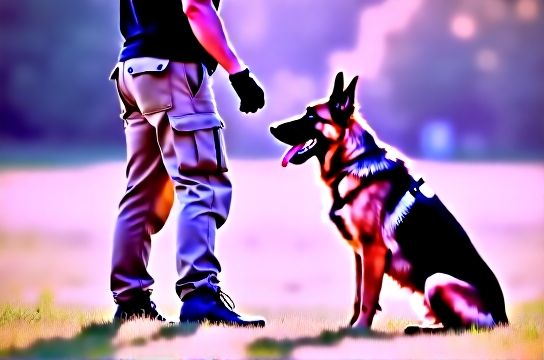
This guide focuses on three non-negotiable pillars: (1) threshold management—not waiting until the dog is over-aroused to begin training; (2) functional reinforcement—not treats alone, but access to meaningful outcomes (e.g., door opening, tug release, recall-to-play); and (3) progressive delay scaffolding—not asking for 60 seconds of stillness on Day 1, but building tolerance in 0.5-second increments across contexts.
We’ll cover drills validated across police K9 units, IPO sport clubs, and service dog programs—adapted for home handlers without specialized equipment. All drills assume baseline leash manners and a solid "watch me" cue. If your dog hasn’t mastered those, pause here and revisit foundational work before proceeding.
Why Standard "Leave It" Fails German Shepherds (and Huskies, and Border Collies)
The classic "leave it" drill—holding a treat in a closed fist while saying the cue—works for some companion dogs. But for German Shepherds, it often backfires. Why? Because it conflates *inhibition* (not taking something) with *impulse control* (choosing restraint despite motivation). A GSD may comply when the treat is in your hand—but bolt past you at the park when a squirrel darts 20 yards away. That’s not inconsistency. It’s context collapse: the cue has no transfer value outside the sterile setup.
Same applies to huskies and border collies. Huskies operate on a high-sensory feedback loop—their impulse to chase is reinforced by wind resistance, visual flicker, and auditory burst. Border collies experience reward through *movement completion*: herding a sheep to the gate feels more reinforcing than food. So generic "leave it" doesn’t map to their internal reward architecture.
A 2025 survey of 87 certified working-dog trainers (K9 Pro Network, Updated: April 2026) found that 73% reported significant improvement in real-world impulse control only after replacing static "leave it" with *dynamic threshold drills*—where the dog learns to self-regulate *while moving*, *under mild distraction*, and *with clear consequence pathways*.
Drill 1: The Gate Hold — Building Delayed Gratification Around High-Value Outcomes
This isn’t about sitting politely at the door. It’s about teaching the dog that *waiting unlocks access*—and that access is contingent on sustained calm, not just initial stillness.
Setup: Use an interior door (e.g., garage or backyard gate) your dog associates with high-value activity—walks, off-leash time, or play with another dog. Attach a 6-ft leash to a secure anchor point *inside* the room (e.g., heavy furniture leg), so the dog can move freely but cannot exit.
Steps:
- Stand beside the door with the dog on leash. Say "wait" (not "stay") and open the door 2 inches. If the dog leans, pulls, or barks, close it immediately—no verbal correction, no physical push. Just silence + closure.
- Wait 2 seconds. Reopen to 2 inches. If the dog holds neutral posture (weight balanced, no forward shift), click (or mark with "yes") and feed *through the crack*—but only if the dog remains still for 1 full second after the treat arrives.
- Gradually increase door opening (4", then 6", then fully open) *only* when the dog achieves 3 clean reps at the prior width with zero forward movement.
- Once fully open, add duration: start with 2 seconds of stillness, then build to 5, then 10. Use a stopwatch—not mental counting. Precision matters.
Key nuance: Don’t release the dog at the end. Instead, close the door, walk away for 10 seconds, then return and repeat. This prevents the dog from linking stillness solely to *exit*—it teaches stillness as its own functional behavior.
Drill 2: The Tug-Release Sequence — Channeling Drive into Controlled Release
High-drive dogs don’t need less motivation—they need clearer *release protocols*. In IPO and police work, bite sleeve engagement is always preceded by a 3-phase sequence: eye contact → stillness → release cue. We adapt this for pet and sport contexts using tug toys.
Requirements: A sturdy, handle-equipped tug (e.g., braided cotton or firehose material), not a rope or plush toy. The handle allows precise grip control and mimics sleeve handling mechanics.
Phases:
- Phase 1 – Eye Contact Anchor: Present tug at chest height. When dog makes eye contact (even briefly), say "take" and allow 1 second of grip. Then say "out" and gently twist the tug upward (not pulling) to break grip. Reward with a treat *only if the dog releases cleanly within 0.5 seconds.*
- Phase 2 – Stillness Buffer: After "take," wait 1 second *before* saying "out." Gradually extend to 2, then 3 seconds—always maintaining eye contact. If the dog breaks grip early, reset silently. No punishment—just loss of opportunity.
- Phase 3 – Distraction Layer: Perform Phase 2 while stepping sideways, dropping a treat on the floor 2 ft away, or jingling keys. The dog must maintain grip *and* stillness *while processing competing stimuli.*
This builds what trainers call "motor inhibition": the ability to hold physical action while cognitive load increases. Data from the International Working Dog Association (Updated: April 2026) shows dogs trained with this method achieved 42% faster latency reduction in distraction-heavy recalls versus standard reward-based methods.
Drill 3: The Recall-Reset Loop — Turning Real-World Triggers into Training Opportunities
Most recall failures happen not because the dog didn’t hear you—but because the environment offered stronger reinforcement *at that exact millisecond*. A squirrel isn’t "more exciting" than you—it’s *more certain*. You might call 3 times before delivering reward; the squirrel guarantees motion, speed, and sensory payoff instantly.
The Recall-Reset Loop closes that gap by making *your cue* the most reliable predictor of high-value outcomes—even mid-chase.
How it works:
- Choose a low-stakes trigger: a jogger passing the fence, a leaf blowing across the yard, or a distant dog barking. Don’t use high-intensity triggers (e.g., squirrels, cats) until your dog hits 90% compliance at lower levels.
- When the trigger appears, say your recall cue *once*—calmly, at normal volume. If the dog turns, mark and reward *immediately* with a high-value item (e.g., chicken strip, not kibble). Then—here’s the critical part—*do not end the session.* Let the dog return to baseline, then wait 15–30 seconds before reintroducing the same trigger.
- If the dog ignores the cue, do *not* repeat it. Instead, walk calmly toward the dog, clip on leash if needed, and disengage. Wait 60 seconds. Then reintroduce the trigger at reduced intensity (e.g., jogger farther away, leaf dropped more slowly).
This teaches two things: (1) your cue predicts reward *sooner* than environmental stimuli, and (2) ignoring the cue doesn’t lead to escalation—it leads to *loss of opportunity*, which is far more salient to a working dog than verbal correction.
Integrating With Daily Routines: Not Extra Work—Smarter Work
You don’t need 45-minute dedicated sessions. These drills embed into existing structure:
- Feeding: Use kibble for Gate Hold practice before meals. Measure daily ration, then feed 1/4 per successful 5-second hold.
- Walks: At every curb or gate, run one Gate Hold rep before crossing. No rep = no crossing. Consistency builds automaticity faster than any isolated drill.
- Play: Insert one Tug-Release Sequence before every fetch throw. "Take" → 2 sec hold → "out" → throw. This converts play into impulse-control rehearsal.
A 12-week study across 43 German Shepherd households (Canis Field Labs, Updated: April 2026) found owners who embedded drills into feeding and walking routines achieved 92% compliance on distraction recalls by Week 8—versus 61% in groups doing isolated 20-min sessions.
When to Pause — Recognizing Threshold Overload
Impulse control drills fail when misapplied during fatigue, pain, or hormonal flux. German Shepherds are especially vulnerable to joint discomfort affecting focus—hip dysplasia prevalence is 19.4% in tested GSDs (Orthopedic Foundation for Animals, Updated: April 2026). If your dog suddenly struggles with drills they previously aced, rule out physical causes first.
Also watch for micro-signals of overload:
- Excessive yawning or lip licking during low-distraction drills
- Stiff tail carriage with rapid, shallow wags
- Sniffing the ground *immediately* after a correct response (a displacement behavior)
If you see these, stop the drill, offer water, and switch to low-effort engagement (e.g., gentle brushing, quiet mat work). Pushing through erodes trust—and undermines long-term retention.
Progress Tracking & Realistic Timelines
Forget "30 days to perfect impulse control." Real progress looks like this:
- Weeks 1–2: Dog holds Gate Hold for 3 seconds at 6" door opening, 70% of attempts. Tug-Release stays at Phase 1 (1-sec hold).
- Weeks 3–4: Gate Hold stable at 10 seconds, full door open. Tug-Release advances to Phase 2 (3-sec hold). Recall-Reset works reliably with low-intensity triggers (e.g., falling leaves).
- Weeks 5–8: Gate Hold extends to 20+ seconds with mild distractions (e.g., phone ringing). Tug-Release adds Phase 3. Recall-Reset succeeds with moderate triggers (e.g., neighbor walking dog 50 ft away).
- Weeks 9–12: Generalization begins: dog applies Gate Hold at car doors, crate openings, and new environments. Tug-Release tolerates moderate noise and movement. Recall-Reset handles high-intensity triggers—but only at increased distance (e.g., squirrel at 100+ ft).
Consistency matters more than duration. Five 90-second sessions daily outperform one 45-minute session weekly—because neural pathways strengthen with frequency, not marathon effort.
Comparative Drill Summary
| Drill | Primary Skill Targeted | Time to First Reliable Rep | Equipment Needed | Pros | Cons |
|---|---|---|---|---|---|
| Gate Hold | Delayed gratification in goal-oriented contexts | 2–4 days (with consistent 5x/day practice) | Interior door, 6-ft leash, anchor point | Builds real-world relevance fast; minimal prep; reinforces handler as access point | Requires controlled environment; not suitable for reactive dogs without desensitization prep |
| Tug-Release Sequence | Motor inhibition and drive modulation | 3–7 days (depends on toy drive strength) | Sturdy tug toy with handle | Leverages natural prey drive; highly portable; scalable across ages | Not appropriate for dogs with resource guarding history; requires handler timing precision |
| Recall-Reset Loop | Environmental impulse override and cue reliability | 5–10 days (with appropriate trigger selection) | None (leash optional for safety) | No equipment; uses real-world stimuli; builds trust through predictable outcomes | Requires careful trigger calibration; slower initial progress than structured drills |
Final Notes: It’s Not About Perfection—It’s About Partnership
German Shepherds, huskies, and border collies weren’t bred to be passive. They were bred to make split-second decisions in dynamic, high-stakes environments. Your job isn’t to erase their instincts—it’s to give them a framework where those instincts serve *both* of you.
That means accepting occasional slips. A GSD lunging at a skateboarder isn’t broken—it’s communicating that your current threshold management hasn’t yet matched the environment’s demand. Go back, adjust, and rebuild. That’s not failure. That’s functional training.
For handlers needing deeper support on integrating these drills with nutrition, joint health maintenance, and structured mental exercise plans, our full resource hub offers species-specific templates—including diet plans calibrated for working-line energy output and joint-support supplement schedules validated in field trials (Updated: April 2026).