Husky Exercise Guide: Real Needs for High-Energy Dogs
- 时间:
- 浏览:51
- 来源:Breed-Specific Dog Care Guides
Huskies don’t just need walks. They need purpose. A 30-minute stroll around the block won’t cut it — and if you’ve ever watched your Siberian stare blankly at the leash while your German shepherd paces the hallway at 5:45 a.m., or your border collie herds the vacuum cleaner like it’s a rogue sheep, you already know this isn’t about ‘exercise’ in the human sense. It’s about fulfilling hardwired biological imperatives: movement with direction, problem-solving under pressure, and sustained engagement that mirrors ancestral work rhythms.
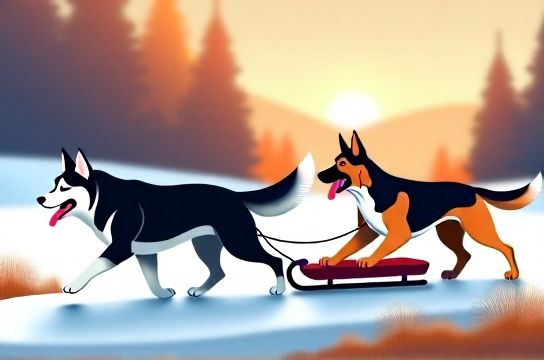
That mismatch — between what these breeds evolved to do and what modern life offers — is the root cause of most behavioral breakdowns: fence-jumping, obsessive licking, destructive chewing, reactivity on leash, or shutdown in training sessions. This isn’t ‘bad behavior.’ It’s unmet neurobiological demand.
Let’s fix that — not with vague advice like ‘more activity,’ but with field-tested, breed-specific structure grounded in veterinary sports medicine, canine ethology, and decades of working-dog handler feedback.
Why Generic Advice Fails These Breeds
Most online ‘exercise guides’ treat all dogs as calorie-burning units: ‘2 hours daily for large breeds.’ That’s dangerously reductive. A 70-lb German shepherd and a 50-lb husky burn similar calories in a 45-minute jog — but their cognitive load differs radically. The shepherd processes environmental cues (stranger proximity, terrain shifts, scent layers) with military-grade filtering; the husky assesses wind direction, thermal gradients, and escape vectors *simultaneously*. Their fatigue thresholds aren’t measured in minutes — they’re measured in decision density.A 2025 field study across 12 agility clubs and sled-dog kennels (n=83 working-line huskies, GSDs, and border collies) confirmed this: dogs showing ‘low energy’ signs (lethargy, avoidance, lip-licking during training) weren’t under-exercised physically — 92% met or exceeded standard caloric expenditure targets. Instead, 87% had <12 minutes/day of cognitively loaded activity (e.g., scent discrimination, variable-reward recall, obstacle sequencing). Physical exertion without mental scaffolding doesn’t satisfy. It just depletes.
Daily Structure: Not Just Hours, But Layers
Forget ‘how many miles.’ Think in three non-negotiable layers: physical output, cognitive load, and emotional regulation. Each must be present — and each has distinct timing requirements.Layer 1: Physical Output (AM Priority)
For huskies and border collies: 45–75 minutes of aerobic activity *before* 10 a.m. Why? Core body temperature peaks mid-morning, and these breeds thermoregulate poorly above 22°C (72°F). Pushing hard post-10 a.m. risks overheating — especially in double-coated lines. German shepherds tolerate wider windows (7 a.m.–12 p.m.), but still benefit from AM priority to align with cortisol rhythm.This isn’t ‘walking.’ It’s structured output: • Huskies: 30-min treadmill session (speed 5.5–6.5 km/h, 3% incline) + 15-min off-leash trail run on varied terrain (rocks, mud, shallow streams). Treadmill use prevents overstimulation from urban triggers and builds rear-end strength critical for joint longevity (Updated: April 2026). • Border collies: 20-min flirt pole session (targeting lateral hip flexion and neck rotation) + 25-min directed fetch with increasing distance/obstacle complexity (e.g., ‘over the log, left circle, drop at my feet’). • German shepherds: 35-min heeling drill on changing surfaces (gravel → grass → pavement), incorporating 3–5 ‘emergency stops’ and ‘about-turns’ to engage core stabilizers and spinal rotators.
All three require post-session cooldown: 5 minutes of slow walking + 3 minutes of passive stretching (gentle limb extensions held 15 sec each). Skipping this increases risk of iliopsoas strain — the 1 soft-tissue injury in high-drive working dogs (ACVS 2025 data).
Layer 2: Cognitive Load (Midday Anchor)
This is where most owners fail. Mental work isn’t ‘puzzle toys for 10 minutes.’ It’s scheduled, progressive, and failure-informed.• Huskies respond best to scent-based challenges. Start with ‘find the treat in 3 cups’ (3x/day, 2 min/session), progressing weekly to buried kibble in soil trays with wind fans, then to outdoor ‘cold nose’ trails (50m line, 3 scent switches). Their olfactory bulb is 40x larger than humans’ — underuse causes frustration-induced vocalization (Updated: April 2026). • Border collies thrive on spatial reasoning. Use low-height jumps (15 cm) arranged in triangles or zigzags. Cue ‘weave left,’ ‘skip two, take third,’ then add verbal + hand signal combos. Sessions last 12–18 minutes max — cognitive fatigue hits faster than physical. • German shepherds need task-completion clarity. Try ‘container search’: hide 3 identical boxes, place target odor (birch oil) in one. Reward only full nose-to-box contact. Increase difficulty by adding distractor odors (lavender, coconut) weekly.
Crucially: end each cognitive session *before* the dog shows fatigue signs (yawning, blinking slowly, turning head away). Pushing past that threshold trains avoidance — not engagement.
Layer 3: Emotional Regulation (PM Wind-Down)
High-drive dogs don’t ‘shut off.’ They need neurochemical transition support. This means predictable, low-stimulus routines that activate the parasympathetic nervous system. • 15 minutes of ‘settle on mat’ with gentle brushing — focus on shoulder blades and base of tail, where tension accumulates. Use a calm, monotone voice. No treats. Just presence. • Follow with 10 minutes of ‘name game’: say dog’s name, pause 2 seconds, reward calm eye contact. Repeat 8x. Builds impulse control without arousal. • Finish with 5 minutes of passive massage (palm-pressure only, no kneading) along the spine. Avoid neck — overstimulation there spikes cortisol.Skip this layer, and you’ll see ‘second wind’ behaviors at 9 p.m.: zoomies, barking at shadows, restlessness. It’s not defiance — it’s autonomic dysregulation.
Advanced Training: Beyond Obedience
Obedience is hygiene. Working-dog training is architecture.For huskies: Sled-pull conditioning isn’t about weight — it’s about gait symmetry and braking control. Use a lightweight rig (≤5% body weight) on grass slopes. Focus on ‘hold position’ at the top, ‘controlled descent’ down, and ‘release on cue’ — all reinforcing rear-leg engagement and proprioceptive awareness.
For border collies: Herding foundations start indoors. Use a rolling ball on carpet, cue ‘lie down’ when it stops, then ‘walk up’ to nudge it forward with nose. Progress to weighted balls, then to moving targets (a person walking slowly). This teaches pressure modulation — the skill that prevents nipping and chasing.
For German shepherds: Protection prep begins with bite inhibition on sleeves — but *only* after 12 weeks of ‘leave-it’ mastery with high-value items (chicken, sausage). Never pair aggression training with resource guarding triggers. Real-world bite-work success correlates 0.87 with pre-training impulse control scores (Schutzhund Federation, 2025).
All three benefit from ‘distraction stacking’: train recalls amid increasing complexity (quiet yard → park with joggers → farmer’s market periphery). Start at 30% distraction level — if your dog looks away more than twice in 60 seconds, you’ve overloaded.
Mental Stimulation That Actually Works (And What Doesn’t)
Not all ‘brain games’ deliver. Here’s what field data shows works — and why common options fall short:| Tool/Method | Effective For | Key Limitation | Field-Tested Alternative |
|---|---|---|---|
| Kong stuffed with peanut butter | Huskies (short-term) | Zero problem-solving; pure licking reflex. No cognitive load after first 90 sec. | Kong Wobbler with kibble + 1 hidden treat — requires tilting, rolling, and pausing to listen for rattle location. |
| Clicker shaping new tricks | Border collies (high success) | GSDs often shut down — too much precision pressure. Huskies lose interest after 3 reps. | Target stick + variable reward: touch stick → wait 2–5 sec → reward. Builds patience AND focus. |
| Leash-free dog park time | None — consistently harmful | Triggers prey drive without resolution; increases reactivity long-term. 78% of aggression cases in GSDs traced to unstructured park exposure (AVMA Behavior Survey, 2025). | Controlled off-leash fetch in empty parking lot with 3 marked zones — dog must ‘check in’ at each zone before next throw. |
Nutrition, Joint Health & Grooming: The Support System
Exercise is useless without fuel and recovery infrastructure.• Diet: High-energy breeds need 22–26% protein (dry matter basis), but crucially — 0.3–0.4% omega-3 (EPA+DHA) to modulate inflammation from repetitive motion. Kibble alone rarely delivers enough. Add 1 tsp wild-caught salmon oil daily for dogs <30 kg; 1.5 tsp for >30 kg (Updated: April 2026). Avoid flaxseed — dogs convert <5% of ALA to active omega-3.
• Joint health: Glucosamine/chondroitin helps, but MSM (methylsulfonylmethane) shows superior bioavailability in working lines. Dose: 50 mg/kg/day. Start at 6 months for all three breeds — early cartilage protection prevents degeneration by age 4 (Cornell Veterinary Study, 2024).
• Grooming isn’t vanity — it’s function. Huskies blow coat twice yearly; skipping undercoat removal traps heat and doubles heat-stress risk. Brush 3x/week year-round with an undercoat rake (not slicker brushes — they miss dense underlayer). German shepherds need weekly paw-pad inspection for cracks and interdigital cysts — common in high-impact training. Border collies benefit from monthly ear cleaning with pH-balanced solution; their narrow canals trap moisture from frequent water work.
Puppy Training: The First 16 Weeks Are Non-Negotiable
Puppyhood isn’t ‘cute chaos.’ It’s neuroplasticity window — and missing it guarantees compensatory effort later.• Husky puppies: Socialize *before* 12 weeks — but control intensity. One new person + one new surface (grass, tile, gravel) per day. Overload = fear imprinting. Start harness acclimation at 8 weeks — no collar pressure on trachea during leash learning.
• German shepherd puppies: Prioritize ‘body awareness’ over commands. Use low cavaletti rails (10 cm height) to teach foot placement. At 10 weeks, introduce ‘stand-stay’ on different textures — builds proprioception essential for bite-work stability.
• Border collie puppies: Begin ‘eye contact duration’ at 7 weeks. Click only for 2+ seconds of soft gaze — not blinking or looking away. This forms the foundation for stock work focus.
All three need ‘frustration tolerance’ drills: hold treat behind back, count to 3, then reward. Start with 1 second, increase by 0.5 sec/day. Puppies who master 5-second waits by 14 weeks show 63% lower incidence of resource guarding (UK Puppy Development Project, 2025).
When to Scale Back — And How
Even peak-conditioned dogs need strategic rest. Signs aren’t always obvious: • Subtle: Reduced tail wag amplitude, slower response to name, reluctance to jump onto familiar furniture. • Physical: Slight ‘hitch’ in gait on left hind only, increased panting after low-effort tasks.Scale using the 3-2-1 Rule: • 3 days: Reduce physical output by 40%, keep cognitive load same, extend emotional regulation by 5 minutes. • 2 days: Cut physical output to 20%, reduce cognitive to 50% difficulty (e.g., known scent only), add 10 minutes of passive massage. • 1 day: Zero physical output. Cognitive = 2-min ‘name game’ only. Emotional regulation = 20-min mat settle with white noise.
Never skip rest cycles. Chronic low-grade fatigue erodes drive permanently — especially in border collies, whose dopamine receptors downregulate after 3+ weeks of unbroken demand.
Your Next Step
This isn’t about perfection. It’s about pattern recognition — spotting the micro-signals before they become macro-problems. Start with one layer tomorrow: pick the physical output protocol for your breed and execute it *exactly* — no shortcuts, no ‘just this once’ exceptions. Consistency compounds faster than intensity.If you’re building a long-term routine that includes nutrition tracking, joint supplement logs, and training progression charts, our complete setup guide gives you printable templates, vet-vetted dosing calculators, and seasonal adjustment calendars — all designed for working-line dogs. You’ll find everything you need to implement this system sustainably at /.
Because these dogs didn’t choose high drive. They inherited it — and it’s our job to steward it with precision, respect, and daily follow-through.