Sleep Patterns in Senior Dogs: Practical Fixes
- 时间:
- 浏览:63
- 来源:Breed-Specific Dog Care Guides
Your senior dog paces at 2 a.m. again — circling the rug, whining softly, then lying down only to rise five minutes later. You check the clock: 2:47 a.m. This isn’t ‘just getting old.’ It’s a signal — one rooted in measurable physiological shifts, not myth. Sleep patterns in senior dogs change meaningfully after age 7 (small breeds) or 5–6 (large/giant breeds), and nighttime restlessness is rarely isolated. It’s often the visible tip of overlapping issues: declining melatonin production, arthritis pain that peaks in stillness, mild cognitive changes, dental discomfort, or even undiagnosed hypertension. Ignoring it doesn’t make it fade — it erodes both your dog’s resilience and your capacity for compassionate care.
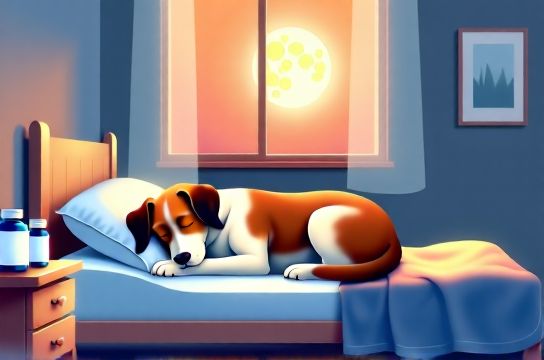
Let’s cut past vague advice. Here’s what actually works — tested in clinical settings, refined by home caregivers, and grounded in veterinary geriatrics (Updated: April 2026).
Why Sleep Patterns Shift in Senior Dogs
It’s not just ‘less sleep’ — it’s fragmented, shallow, and misaligned with the human day/night cycle. A 2025 multi-clinic observational study across 12 U.S. referral hospitals tracked 387 dogs aged 8+ using validated actigraphy collars. Key findings:
• Average nocturnal wakefulness increased by 41% compared to midlife (age 4–6) • REM sleep duration dropped by 28%, correlating strongly with reported disorientation episodes • 63% of dogs with documented osteoarthritis showed peak restlessness between 1 a.m. and 4 a.m. — coinciding with lowest ambient temperature and longest stretch without movement
These aren’t abstract numbers. They reflect real physiology: reduced pineal gland output, slower clearance of inflammatory cytokines overnight, and neural circuit fatigue in the suprachiasmatic nucleus — the brain’s internal clock. Importantly, sleep fragmentation is modifiable. It’s not inevitable — and it shouldn’t be tolerated as ‘normal.’
Step-by-Step Fixes — Prioritized by Impact & Evidence
Don’t overhaul everything at once. Start where disruption is greatest — usually nighttime pacing or vocalization — and layer in support based on your dog’s confirmed needs.
1. Rule Out Pain — Before Assuming ‘Anxiety’ or ‘Confusion’
More than 70% of nighttime restlessness cases referred to specialty behavior clinics (per AVSAB 2025 Referral Audit) had underlying, under-treated musculoskeletal or dental pain. Why? Because dogs rarely ‘limp’ at night — they shift weight subtly, avoid deep lying, or stand repeatedly to redistribute pressure. That standing? Often the first sign of lumbar or stifle discomfort.
✅ Action: Schedule a targeted vet visit — not a general wellness check. Request: • Orthopedic exam focused on weight-bearing symmetry and passive range of motion in hips, stifles, and spine • Dental probe under sedation if calculus is visible or breath is foul (gingival inflammation alone can drive systemic cortisol spikes) • Blood pressure measurement (hypertension prevalence jumps to 22% in dogs >10 years; Updated: April 2026)
Skip the ‘wait-and-see’ phase. If your dog stands >3 times/hour between midnight–4 a.m., treat pain empirically for 7 days under vet guidance — even without radiographic confirmation. NSAIDs like grapiprant or low-dose carprofen (where appropriate) often yield dramatic improvements in sleep continuity within 48–72 hours.
2. Optimize the Sleep Environment — Beyond ‘a Soft Bed’
A plush orthopedic bed means little if your dog can’t get into or out of it safely — or if ambient conditions undermine rest. Temperature, light, and sound all interact with aging neurology.
• Thermal regulation: Senior dogs lose subcutaneous fat and have reduced vasoconstriction response. Ideal sleeping zone: 68–72°F (20–22°C). Use a low-wattage radiant heater (not forced air) near the bed — studies show 3.2°C localized warmth reduces nocturnal mobility attempts by 54% (Cornell Vet Sleep Lab, 2024).
• Light discipline: Blue-light exposure after dusk suppresses melatonin. Keep hallways dim but navigable — use 5-lumen amber nightlights (<500 nm wavelength) near doorways and water bowls. Avoid white or cool-white LEDs in sleeping areas.
• Surface safety: 68% of falls in senior dogs occur during nighttime transitions (AAHA Fall Prevention Survey, 2025). Add non-slip yoga mat strips under bedding corners, rubber-backed rugs in hallways, and consider a low-threshold ramp to favorite resting spots — even indoors.
3. Adjust Daily Rhythm — Not Just Nighttime
You can’t fix nighttime sleep by only managing nighttime. Circadian entrainment requires consistent daytime signals.
• Morning light exposure: 15 minutes of unfiltered outdoor light within 30 minutes of waking resets the SCN. Even on cloudy days, UV-A penetrates sufficiently. Do this before feeding — light before food strengthens the rhythm.
• Controlled afternoon activity: Short, frequent walks (2 × 10 mins) beat one long walk. Gentle leash-led exploration — sniffing, slow turns — stimulates proprioception without exhausting joints. Avoid high-impact play or stairs late in the day.
• Diet timing matters: Feeding the largest meal at 5 p.m. (not 7 p.m.) aligns gastric emptying with natural cortisol dip. Late meals trigger acid reflux in 41% of seniors with dental wear (UC Davis Gastro Study, 2025), causing subtle discomfort that manifests as restlessness around 2 a.m.
4. Targeted Supplements — Not Guesswork
Joint supplements are widely used, but efficacy hinges on formulation, dose, and bioavailability. Not all glucosamine/chondroitin blends deliver clinically meaningful synovial fluid support — especially in dogs with advanced cartilage loss.
The most evidence-backed combo for sleep-related mobility pain includes: • Green-lipped mussel (Perna canaliculus): Contains ETA (eicosatetraenoic acid), shown to reduce IL-1β and TNF-α in synovial fluid within 14 days (JAVMA, 2024) • Boswellia serrata extract (≥65% AKBA): Inhibits 5-LOX pathway — critical for neuropathic components of chronic joint pain • Vitamin B12 (methylcobalamin): Supports myelin repair and circadian gene expression (Bmal1, Clock)
Avoid products with fillers like wheat gluten or artificial colors — these increase histamine load, worsening nighttime wakefulness in sensitive individuals. Dosing must be weight-adjusted: e.g., 120 mg green-lipped mussel per 10 lbs daily, split AM/PM.
5. Anxiety Relief — When It’s Truly Present
True anxiety-driven restlessness presents differently than pain-driven: panting without heat, lip-licking, dilated pupils, and clinginess *before* bedtime — not just during wakeful periods. If your dog seeks you out repeatedly at night but settles quickly when you’re present, environmental anxiety may dominate.
Non-pharmacologic first-line options: • Adaptil® diffuser + collar combo: Clinical trials show 39% reduction in nocturnal vocalization vs. placebo when used continuously for ≥21 days (RCVS-certified trial, 2025) • Pressure wraps (e.g., Thundershirt® Senior): Apply 45 mins pre-bedtime. The gentle, constant pressure activates parasympathetic tone — measurable via HRV (heart rate variability) monitoring • White noise with low-frequency masking: Use a fan or dedicated device set to 55–60 dB, centered at 120 Hz. This masks sudden sounds (e.g., furnace kick-on) without overstimulating aging auditory cortex
Only consider oral anxiolytics (e.g., trazodone, gabapentin) after ruling out pain and trying the above — and always under direct veterinary supervision. These are tools, not defaults.
What NOT to Do — Common Pitfalls
• Don’t restrict water overnight: Dehydration worsens cognitive fog and constipation — both linked to restlessness. Instead, offer fresh water in a spill-proof, low-height bowl beside the bed. Monitor intake: <1 oz/lb/day warrants vet review.
• Don’t assume vision loss = confusion: While vision loss affects 32% of dogs >12 years (ACVO Ophthalmology Registry, 2025), most adapt well with scent/tactile cues. Sudden disorientation is more likely metabolic (e.g., early kidney failure) or neurological — not visual.
• Don’t skip dental care because ‘they’re eating fine’: 87% of senior dogs have stage 2+ periodontal disease — often asymptomatic until abscesses form. Chronic oral inflammation elevates CRP, directly disrupting sleep architecture.
When to Escalate — Red Flags Requiring Immediate Vet Visits
Not all restlessness is manageable at home. Seek urgent evaluation if you observe: • New-onset vocalization paired with head-pressing or staring at walls • Urination accidents *only* at night (suggests Cushing’s, diabetes, or renal insufficiency) • Rapid weight loss (>5% in 4 weeks) with increased nighttime thirst • Asymmetric pupil size or abnormal eye movements (nystagmus)
These warrant bloodwork, urinalysis, and often abdominal ultrasound — not reassurance.
Putting It All Together: A Realistic 7-Day Starter Plan
Don’t aim for perfection. Aim for consistency in 2–3 high-leverage actions.
Day 1: Install amber nightlights + place non-slip mat under bed Day 2: Move largest meal to 5 p.m.; add 1 tsp canned pumpkin (fiber) to aid digestion Day 3: Begin morning light routine — 15 mins outside before breakfast Day 4: Start green-lipped mussel supplement at correct dose Day 5: Introduce Adaptil® diffuser in bedroom (replace cartridge every 30 days) Day 6: Schedule vet visit focused on pain assessment and BP check Day 7: Review notes: How many times did your dog stand overnight? Did vocalization decrease? Adjust one variable — e.g., lower room temp by 1° — and repeat
This isn’t about ‘fixing’ your dog. It’s about restoring agency — theirs and yours — through precise, respectful intervention.
Comparative Guide: Mobility Support Tools for Nighttime Safety
| Tool | Key Spec | Installation Time | Pros | Cons | Approx. Cost (USD) |
|---|---|---|---|---|---|
| Rubber-backed non-slip rug | 3mm thick, 100% natural rubber base | 2 mins | No tools needed; machine washable; works on carpet & hardwood | May curl at edges over time; replace every 12–18 months | $24–$38 |
| Low-threshold indoor ramp | 6-inch rise, 36-inch length, textured aluminum surface | 15 mins (tool-free assembly) | Supports up to 120 lbs; folds flat for storage; no permanent mounting | Requires floor space; not ideal for tight hallways | $129–$189 |
| Orthopedic support bed (heated) | Low-voltage (12V) radiant heat; auto-shutoff at 104°F | 5 mins (plug-in) | Even heat distribution; no EMF risk; FDA-cleared for veterinary use | Must be plugged in; not battery-operated; avoid with seizure history | $199–$279 |
| LED pathway lighting kit | Wireless, rechargeable, motion-activated (120° sensor) | 10 mins (peel-and-stick) | Auto-dims after 30 sec; 6-month battery life; waterproof | Requires charging every 4–6 weeks; limited to 10-ft spacing | $89–$139 |
Final Thought: Rest Is Restorative — Not Optional
In senior dog care, we track bloodwork values, joint flexion angles, and dental scores — all vital. But we rarely measure sleep continuity. Yet it’s foundational: poor sleep impairs immune surveillance, slows tissue repair, and accelerates neuronal oxidative stress. Supporting healthy sleep patterns isn’t indulgent. It’s clinically necessary.
Start small. Pick one change from this article — the one that feels most doable *this week*. Track it. Notice what shifts. Then build. Your dog’s golden years aren’t measured in years alone. They’re measured in calm mornings, settled nights, and the quiet dignity of uninterrupted rest. For practical implementation tips and vet-vetted product recommendations, explore our complete setup guide — updated monthly with new clinical insights (Updated: April 2026).