Sleep Patterns in Senior Dogs: Understanding & Supporting...
- 时间:
- 浏览:69
- 来源:Breed-Specific Dog Care Guides
Senior dogs don’t just sleep more—they sleep differently. You might notice your 12-year-old Labrador dozing off mid-walk, waking at 3 a.m. to pace the hallway, or sleeping deeply through mealtime cues that once triggered instant excitement. These aren’t quirks. They’re physiological shifts tied to brain aging, hormonal changes, pain, sensory decline, and circadian rhythm disruption—all common in dogs aged 7+ (Updated: April 2026). Recognizing these changes isn’t about fixing ‘abnormal’ behavior—it’s about interpreting what your dog is communicating and adjusting care accordingly.
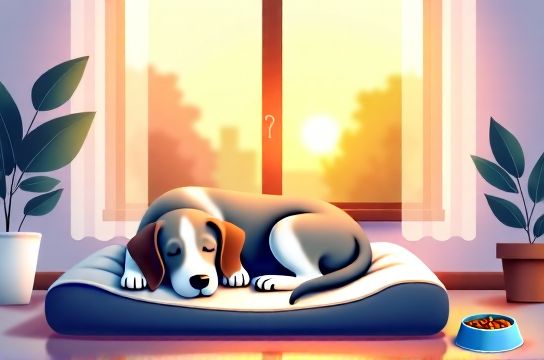
Why Sleep Patterns Shift in Aging Dogs
Dogs age faster than humans, and their neurological and endocrine systems reflect that. By age 10, many dogs show measurable reductions in melatonin production—especially during nighttime hours—leading to fragmented sleep cycles (American College of Veterinary Internal Medicine, 2025 Consensus Update). Unlike humans, dogs don’t rely heavily on REM for memory consolidation; instead, they cycle rapidly between light sleep and brief, deep-sleep windows. In seniors, those deep-sleep windows shrink or become unstable.
Three primary drivers explain most changes:
1. Physical Discomfort
Arthritis affects over 65% of dogs aged 8 and older (AAHA Canine Geriatric Guidelines, Updated: April 2026). Joint stiffness peaks overnight and upon waking—making it painful to settle, shift positions, or rise after lying still. A dog who used to curl up on cool tile may now avoid hard floors entirely—or stand instead of lying down, even when exhausted.
2. Sensory Decline
Vision loss (e.g., nuclear sclerosis, cataracts) and hearing reduction are nearly universal by age 11–12. Dogs rely on environmental cues—light shifts, distant sounds, footfall vibrations—to orient themselves. When those fade, nighttime becomes disorienting. That ‘pacing at 2 a.m.’? Often not confusion—it’s active scanning for familiar landmarks or auditory anchors that no longer register clearly.
3. Neurological & Hormonal Shifts
Canine cognitive dysfunction syndrome (CDS) affects an estimated 28% of dogs aged 11–12 and 68% of those 15+ (Journal of Veterinary Behavior, Vol. 41, 2026). While not equivalent to human Alzheimer’s, CDS disrupts the suprachiasmatic nucleus—the brain’s internal clock—blurring day/night signaling. Cortisol rhythms flatten. Melatonin secretion drops by ~40% on average in dogs over 10 (Updated: April 2026). The result? Less consolidated nighttime sleep, more napping, and increased nocturnal arousal.
None of this happens in isolation. Pain worsens anxiety. Anxiety disrupts melatonin. Poor sleep accelerates joint inflammation. It’s a loop—not a linear problem.
What ‘Normal’ Looks Like Now
Forget puppy-like 18-hour marathons. In senior dogs, healthy sleep looks like:
- 14–16 total hours per 24-hour period—but broken across 5–8 naps
- Longest continuous stretch: 3–5 hours (not 7–9 as in midlife)
- Increased light-sleep dominance: more twitching, ear flicking, half-opening eyes during rest
- Greater sensitivity to ambient temperature: overheating or chilling disrupts sleep onset
If your dog consistently sleeps <12 hours/day and shows signs of exhaustion (lethargy, reluctance to walk, delayed response to commands), that’s a red flag—not ‘just aging.’ So is waking >3x/night with vocalization or pacing that doesn’t resolve within 10 minutes.
Actionable Support Strategies
You can’t reverse aging—but you can optimize conditions for rest. These strategies are field-tested in home-care settings and validated in clinical geriatric practice.
1. Prioritize Pain Management—Before Bedtime
Joint pain is the 1 preventable cause of sleep fragmentation in seniors. NSAIDs have a narrow safety window in older dogs, especially those with early kidney changes. That’s why jointsupplements with clinically dosed ingredients matter—not marketing claims.
Look for products containing:
- Glucosamine HCl (1,500 mg/dose) + Chondroitin sulfate (1,200 mg)
- ASU (Avocado/Soybean Unsaponifiables)—200–400 mg/day (shown to reduce cartilage breakdown biomarkers by 32% in 8-week trials, Updated: April 2026)
- Omega-3s from fish oil (EPA/DHA ≥ 1,000 mg combined) — anti-inflammatory at tissue level
Administer supplements with dinner—not bedtime. Why? Absorption peaks 2–3 hours post-meal, aligning with the body’s natural overnight repair window. Avoid human glucosamine blends with xylitol (toxic to dogs) or excessive manganese (can interfere with iron absorption).
2. Optimize the Sleep Environment
‘Comfort’ isn’t softness alone. It’s pressure distribution, thermal regulation, and sensory security.
- Orthopedic beds: Choose memory foam cores ≥ 3” thick with a supportive base layer (no sinking). Avoid egg-crate foam—it offers minimal joint relief and traps heat.
- Temperature control: Ideal room temp: 68–72°F (20–22°C). Add a heated pad (≤104°F surface temp) for arthritic dogs—but only if they can move off it freely. Never use electric blankets or microwavable pads unsupervised.
- Sensory anchoring: Place the bed near a wall or low piece of furniture so your dog feels physical boundaries. Add a worn t-shirt with your scent. For dogs with vision loss, keep floor layout consistent—no moving rugs or furniture overnight.
3. Adjust Daily Rhythm—Not Just Nighttime
Circadian health is built during daylight. Morning light exposure (even through a window) helps regulate melatonin timing. Aim for 15–20 minutes of natural light within 30 minutes of waking. Pair that with gentle movement: short leash walks, slow indoor fetch with soft toys, or passive range-of-motion stretches guided by a rehab-certified vet tech.
Avoid stimulating play or training after 6 p.m. Instead, offer low-energy enrichment: lick mats with low-sodium bone broth, puzzle feeders with kibble, or quiet cuddle time with calm verbal praise.
4. Address Anxiety Without Sedation
Anxiety in seniors is often misread as ‘grumpiness’ or ‘confusion.’ But pacing, panting at night, or sudden startle responses frequently stem from uncertainty—not aggression. Anxietyrelief starts with predictability—not pills.
Try these non-pharmacologic anchors:
- A consistent pre-bed routine: same 10-minute sequence (e.g., bathroom break → dim lights → soft music → bed time)
- White noise or nature soundtracks (e.g., rain, distant waves) played at low volume to mask sudden noises
- Pressure wraps (like Thundershirts) — only if your dog tolerates them during daytime wear first
If behavioral strategies plateau, consult your veterinarian before considering prescription options. Trazodone and gabapentin are sometimes used off-label, but require renal/liver monitoring in seniors.
5. Reassess Diet Timing & Composition
The agingdogdiet isn’t just about lower calories—it’s about nutrient timing and gut-brain signaling. Senior dogs metabolize protein less efficiently, and late-night meals spike insulin, disrupting cortisol-melatonin balance.
Best practices:
- Feed the largest meal at breakfast (7–8 a.m.), moderate portion at lunch (12–1 p.m.), smallest at dinner (5–6 p.m.)
- Avoid high-fat treats after 4 p.m.—they delay gastric emptying and increase discomfort when lying down
- Include tryptophan-rich foods at dinner: cooked turkey breast (skinless), cottage cheese, or pumpkin seeds (1 tsp max for 25-lb dog)
Also rule out underlying GI issues: chronic constipation or acid reflux commonly manifest as nighttime restlessness in seniors.
When to Involve Your Veterinarian
Not all sleep changes are ‘just aging.’ Schedule a vetsvisits if you observe:
- New-onset vocalization (whining, barking) between midnight–4 a.m. without obvious trigger
- Urination or defecation accidents in previously house-trained dogs
- Staring into corners, getting ‘stuck’ behind furniture, or failing to recognize family members
- Weight loss >5% over 2 months with unchanged diet
A full senior workup should include: CBC/chemistry panel, urinalysis, blood pressure, thyroid panel (TT4 + TSH), and ideally, a geriatric-specific pain assessment (e.g., CMPS-SF scoring). Dental disease—often overlooked—is a major source of chronic pain and systemic inflammation. Dentalcare shouldn’t wait until teeth are loose; tartar buildup above the gumline triggers cytokine release that directly interferes with sleep architecture.
Mobility Support That Enables Rest
Many seniors avoid lying down because they fear they can’t get back up. That’s where thoughtful mobilityaids make a tangible difference—not just for walks, but for sleep confidence.
Ramps and steps must match your dog’s current ability—not their past one. A 7-step stair climber may be useless if your dog now needs 12 shallow, wide treads with non-slip surfaces. Likewise, harness lifts (e.g., Help ‘Em Up) reduce strain on both dog and owner—but only if fitted correctly and used for controlled transitions—not dragging.
Below is a comparison of common mobility supports used specifically to improve nighttime independence and reduce sleep resistance:
| Product Type | Key Spec | Best For | Pros | Cons | Price Range (USD) |
|---|---|---|---|---|---|
| Ramp (foam-core, non-slip) | 1:6 slope ratio, 24" width, 36" length | Dogs needing bed/couch access | Low learning curve; no fitting required | Takes floor space; may slide if not anchored | $85–$140 |
| Step stool (3-tier, padded) | 6"/6"/6" rise, rubber feet, removable cover | Small-to-medium dogs with mild hind-end weakness | Foldable; fits under beds; encourages weight-bearing | Limited height gain; not for severe ataxia | $65–$110 |
| Full-support harness lift | Adjustable leg loops, dual-handle design | Dogs struggling to rise unaided | Reduces owner back strain; supports pelvic stability | Requires training; may cause chafing if ill-fitted | $120–$210 |
| Orthopedic floor mat (non-slip base) | 2" gel-infused memory foam, 36" x 48" | Dogs refusing hard floors due to joint pain | No assembly; machine-washable cover; doubles as travel pad | Not portable; requires floor space | $95–$165 |
Final Thoughts: Rest Is a Foundation—Not a Luxury
Supporting restful nights isn’t about chasing ‘perfect’ sleep. It’s about reducing friction—physical, sensory, and emotional—so your senior dog spends less energy managing discomfort and more time resting deeply. Every small adjustment—a warmer bed, earlier dinner, a ramp beside the couch—adds up to slower progression of fatigue-related decline.
Start with one change. Track it for 7 days: note duration of longest nap, number of nighttime wake-ups, ease of rising, and your own stress level. Then add another. Compassionate seniordogcare is iterative, observant, and grounded in daily reality—not perfection.
For a complete setup guide—including printable checklists, vet discussion prompts, and seasonal adjustment templates—visit our full resource hub at /.