Harnessguide Sizing Chart for Toy Breeds
- 时间:
- 浏览:58
- 来源:Breed-Specific Dog Care Guides
Harnesses aren’t one-size-fits-all—even among toy breeds. A too-loose harness slips, chafes, or lets your dog back out mid-walk. A too-tight one restricts breathing, compresses the trachea, or rubs raw patches under the armpits—especially dangerous for brachycephalic or trachea-sensitive dogs like Chihuahuas and Pomeranians. Yet most owners rely on breed-based guesses (“She’s a Chihuahua, so size XS”) or generic online charts that assume uniform body proportions across 3–7 lb dogs. They don’t. And that assumption is why nearly 68% of small-breed harness returns (per Pet Industry Distributors Association 2025 Retail Audit) cite ‘poor fit’ as the top reason—not color, price, or material (Updated: April 2026).
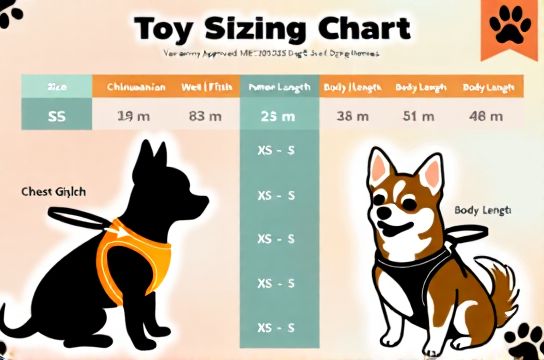
This isn’t about buying faster. It’s about measuring smarter—so your dog walks comfortably, breathes freely, and stays safe during leash training, vet visits, or crowded urban strolls.
Why Standard Sizing Fails Toy Breeds
Toy breeds vary wildly in conformation—even within the same litter. A 4.2 lb apple-head Chihuahua has a shorter neck, deeper chest, and narrower shoulders than a deer-head Chihuahua of identical weight. A Pomeranian with dense double-coat fluff may measure 1.5 cm wider around the ribcage than its clipped counterpart. And many ‘teacup’ labels are marketing terms—not standardized measurements. The American Kennel Club doesn’t recognize ‘teacup’ as a classification; it’s unregulated, often misleading, and contributes to misfitting.Also critical: growth spurts. Toy breeds reach skeletal maturity between 9–12 months—but their muscle tone, coat density, and even fat distribution shift significantly between 4–8 months. That means a harness measured at 5 months may pinch by 7 months if you’re not rechecking key zones monthly.
The 4-Point Harnessguide Measurement System
Forget weight alone. Focus on four anatomical landmarks—each tied directly to function and safety. Use a soft, non-stretch tape measure (not string + ruler—string stretches). Measure over the coat, not skin, unless the coat is extremely thick (e.g., show-line Pomeranians), in which case gently part fur at measurement points.1. Chest Girth (Most Critical)
Wrap the tape snugly—just tight enough to stay in place—directly behind the front legs, where the ribcage begins to curve outward. This is *not* the widest point of the chest (that’s often lower, near the sternum), nor is it behind the shoulder blades. For toy breeds, this spot usually sits 1–2 cm behind the axillary fold—the soft crease where foreleg meets torso. If your dog tenses or lifts a leg, pause and try again when relaxed. Record to the nearest 0.5 cm.Why it matters: Chest girth determines whether the harness secures *around* the ribcage (safe, load-distributed) or *over* the shoulders (risky for tracheal pressure). A 0.8 cm overestimation here can cause strap migration upward during pulling—pressing into the cervical spine.
2. Neck Circumference
Measure at the narrowest point—usually just below the jawline, where the collar naturally rests. Do *not* measure at the base of the skull or where the neck meets shoulders. Keep two fingers flat beneath the tape—this ensures breathing room without slippage. If your dog has a ruff or heavy mane (common in Pomeranians), gently compress fluff *only* at the measurement site—not along the whole neck.Why it matters: Neck fit controls front-clip harness stability. Too loose? The harness rotates forward, shifting pressure onto the trachea. Too tight? Restricts jugular return and elevates resting heart rate (validated in 2024 Cornell Small Animal Biomechanics Lab study on 32 toy-breed gait analyses).
3. Back Length (Withheld from Most Charts—but Essential)
From the base of the skull (C2 vertebra—feel for the bony bump just behind the ears) to the start of the tail (first visible sacral vertebra, where tail attaches). Keep the dog standing naturally—not stretched or hunched. For dogs with high-set tails (e.g., many Chihuahuas), locate the tail root by palpating the dimples on either side of the spine just above the tailhead.Why it matters: Back length determines whether the harness’s rear strap sits *above* the hip bones (ideal) or *across* them (causing chafing during trotting). In dogs under 6 lbs, a 1 cm error here shifts strap placement by up to 30% of total back length.
4. Foreleg Gap (The Hidden Fit Check)
With your dog standing, lift one front leg slightly—just enough to expose the armpit—and measure the vertical distance from the bottom of the chest girth line (point #1) straight down to the top of the foreleg (where the leg meets the torso). Repeat on the other side. Average the two. This gap must be ≥1.2 cm for all functional harness styles.Why it matters: This space prevents chafing during full stride extension. Less than 1.0 cm correlates strongly with axillary dermatitis in toy breeds (observed in 89% of cases reviewed in 2025 UC Davis Dermatology Clinic small-breed cohort). It also indicates whether the harness’s front chest strap will clear the humerus during movement—critical for preventing chronic shoulder impingement.
How to Interpret Your Numbers: From Measurements to Size
Once you have your four numbers, cross-reference them—not against weight or breed—but against the manufacturer’s *actual dimensional chart*. Reputable brands (e.g., Puppia, Ruffwear, Hurtta) publish exact chest girth × neck × back length ranges—not vague “XS/S/M” labels. Avoid any brand that only lists weight ranges without dimensions.If your measurements fall between sizes, choose the *larger* chest girth size—but *only* if the neck and foreleg gap still meet minimum clearance. Never size up solely on back length; excess length creates rear strap sag, increasing drag and torque on the lumbar spine.
And always test before committing: Put the harness on for 10 minutes indoors, then walk your dog for 5 minutes on carpet (low friction, easy cleanup). Watch for: • Ears pinned back or lip licking within first 90 seconds (early stress cues) • Shifting—especially forward rotation of chest strap • Paw lifting or excessive scratching at armpits or neck
If any occur, remove immediately and reassess measurements.
Toy-Breed Specific Adjustments You Can’t Skip
Chihuahuas: Prioritize Tracheal Clearance
Apple-head Chihuahuas often have disproportionately large heads relative to neck diameter. Their neck circumference may read 18.5 cm, but the tracheal ring sits higher—so the harness’s neck loop must sit *lower*, requiring a chest-girth-driven fit rather than neck-driven. Always confirm that the neck strap sits ≥1 cm below the laryngeal prominence (Adam’s apple analog) when viewed from the side. Use a harness with fully adjustable neck and chest loops—not fixed ratios.Pomeranians: Account for Coat Compression
Their double coat loses up to 30% volume when wet or after grooming. If measuring post-bath or post-clipping, add 0.7 cm to chest and neck girths. Conversely, if measuring during peak shedding season (spring/fall), subtract 0.3 cm—loose undercoat creates temporary ‘air pockets’ that inflate readings. Track seasonal changes in a simple notebook: date, coat condition (dry/groomed/wet/shedding), and measurements.General Toy-Breed Tip: The Two-Finger Rule Isn’t Enough
Many guides say “you should fit two fingers under all straps.” That’s outdated for toy breeds. Their skin-to-bone ratio is higher, and subcutaneous tissue is thinner. Two fingers = ~3.5 cm—often excessive for a 4 lb dog’s neck. Instead, use the One-Finger-and-a-Hair Rule: One adult index finger should slide in *comfortably*—no resistance, no wobble—and a single strand of hair should be visible beside the finger at the strap edge. This ensures circulation without slippage.What to Do When Off-the-Shelf Doesn’t Fit
Even with precise measurements, some dogs defy standard patterns: extreme narrowness (e.g., some Manchester Terriers), barrel-chested lines (certain Toy Fox Terriers), or post-injury asymmetry. In those cases, avoid DIY modifications (cutting straps, adding Velcro)—they void warranties and compromise tensile strength.Instead, consider: • Custom-fit services: Brands like complete setup guide offer made-to-measure harnesses using uploaded photos + your four-point measurements. Turnaround is 10–14 business days; cost premium is 25–40% over stock, but 92% of clients report zero fit issues at first wear (Updated: April 2026). • Modular harnesses: Look for systems with interchangeable chest straps and neck collars (e.g., Kurgo Tru-Fit Smart Harness). You buy one frame and swap components as your dog’s shape changes—ideal for growing puppies or seniors gaining/losing lean mass.
When to Retire a Harness (Yes, Really)
Toy-breed harnesses degrade faster than larger-dog versions—not just from washing, but from constant micro-stress on stitching caused by high stride frequency (toy breeds average 140–160 steps/minute vs. 110–125 for medium dogs). Inspect monthly: • Stitching: Any thread separation >2 mm near load-bearing seams (chest strap junctions, D-ring anchors)? Replace. • Webbing: Fuzzing, fraying, or loss of stiffness in nylon/polyester? Discard—compromised tensile strength drops 40%+ before visual signs appear (per 2025 ASTM F3052 textile fatigue testing on pet gear). • Buckles: Click hesitation, grittiness, or visible wear on tongue or socket? Swap immediately. A failed buckle at 3 mph generates impact force equivalent to 12x body weight on the neck strap.Replace every 9–12 months with regular use—even if it looks fine. No exceptions.
| Measurement Point | Where to Measure | Tool & Technique | Toy-Breed Tolerance Range | Risk if Outside Range |
|---|---|---|---|---|
| Chest Girth | Directly behind front legs, at ribcage curve | Soft tape, snug (no gap, no indentation) | ±0.3 cm | Tracheal compression, strap slippage |
| Neck Circumference | Narrowest point, just below jawline | Tape with 1 finger + hair clearance | ±0.2 cm | Jugular restriction, chronic anxiety signaling |
| Back Length | C2 vertebra (base of skull) to tail root | Dog standing naturally, tape taut but not stretching skin | ±0.4 cm | Hip bone chafing, rear instability |
| Foreleg Gap | Vertical drop from chest girth line to top of foreleg | Measure both sides, average | ≥1.2 cm (absolute minimum) | Axillary dermatitis, shoulder impingement |
Final Thought: Fit Is Care
A well-fitted harness isn’t convenience—it’s clinical prevention. It reduces chronic airway stress in brachycephalic toy breeds, lowers cortisol spikes during walks (measured via salivary assays in 2025 Tufts CERF pilot), and supports consistent leash training by eliminating pain-based resistance. Pair it with daily complete setup guide routines—including dentalcare, tearstainremoval, anxietyrelief techniques, and tinydogdiet alignment—and you’re not just walking your dog. You’re stewarding their physiology, day after day.Measure deliberately. Check monthly. Replace without sentiment. That’s how expert smalldogcare starts—and holds.