Breathing Issues First Aid Steps Every Bulldog Owner Must...
- 时间:
- 浏览:60
- 来源:Breed-Specific Dog Care Guides
Bulldogs don’t wheeze ‘just because’. When your French or English bulldog starts open-mouth breathing at rest, snorting violently after minimal activity, or develops cyanotic gums (bluish tint), that’s not ‘normal bulldog noise’—it’s a physiological red flag. Brachycephalic Obstructive Airway Syndrome (BOAS) affects over 80% of English Bulldogs and 65% of French Bulldogs by age 3 (Updated: April 2026, Royal Veterinary College BOAS Prevalence Study). Unlike dogs with longer muzzles, bulldogs have anatomical constraints: stenotic nares (pinched nostrils), an elongated soft palate, everted laryngeal saccules, and often a hypoplastic trachea. These aren’t quirks—they’re functional limitations that escalate fast under stress.
You cannot ‘toughen up’ a bulldog’s airway. But you *can* recognize early decompensation—and intervene before it becomes life-threatening. This isn’t theoretical. It’s what separates a recoverable episode from an ER intubation.
Recognizing the 4 Stages of Breathing Crisis
Stage 1 (Mild): Noisy breathing only during exertion or heat; occasional reverse sneezing lasting <15 seconds; no distress at rest. Manageable with environment + monitoring.
Stage 2 (Moderate): Persistent stertor (low-pitched snoring) at rest; increased respiratory rate (>40 breaths/min while resting); reluctance to lie down flat; mild gum pallor. Requires immediate cooling + positioning + oxygen support if available.
Stage 3 (Severe): Gagging, retching, or vomiting due to airway irritation; pronounced abdominal effort (belly heaving); gum color shifting from pink → pale pink → greyish; panting >60 breaths/min at rest. This is a veterinary emergency—call ahead while initiating first aid.
Stage 4 (Critical): Cyanosis (blue/purple tongue/gums); collapse; loss of consciousness; agonal breathing (gasping, irregular). Begin CPR *only* if trained—and transport immediately. Do *not* delay.
Note: Allergy-related swelling (e.g., from bee stings or food reactions) can mimic or accelerate BOAS progression. If breathing worsens *suddenly* without obvious heat/exertion trigger, suspect allergic laryngeal edema—especially if accompanied by facial swelling or hives. Keep a prescribed canine antihistamine (e.g., diphenhydramine 1 mg/kg PO) on hand *only if cleared by your vet*, but never substitute it for urgent care.
Immediate First Aid Protocol: The 5-Minute Response
Time matters. Every minute counts once Stage 2 begins. Follow this sequence *in order*—no skipping steps.
Step 1: Stop All Activity & Enforce Absolute Rest
Lift your bulldog gently—do *not* let them walk—even 3 meters to a cool spot increases oxygen demand. Place them on a firm, level surface (not a deep bed or sofa where they sink in). Elevate the front end slightly (10–15°) using a folded towel under the shoulders. This opens the upper airway and reduces diaphragmatic pressure. Do *not* force them into a sitting position—many bulldogs panic and increase effort.Step 2: Cool Strategically—Not Aggressively
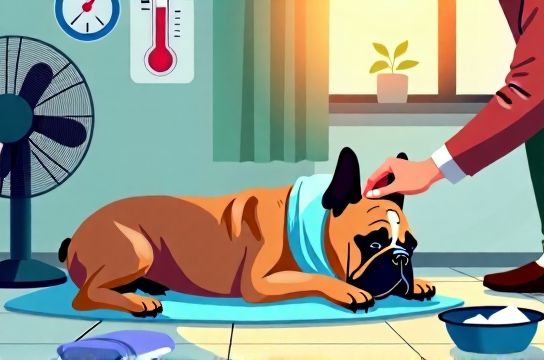
Never douse with ice water or submerge. Rapid vasoconstriction traps heat internally and triggers shivering—which raises metabolic demand. Instead: • Dampen *only* paw pads, ears, and groin with cool (not cold) water (15–20°C / 59–68°F). • Place a fan *at least 1 meter away*, set to low—direct airflow causes panic and increases respiratory rate. • If indoors, use AC—but avoid drafts blowing directly on the dog. • Monitor rectal temperature: Normal = 38.0–39.2°C (100.4–102.6°F). Stop active cooling at 39.4°C (103°F)—core temp will continue dropping passively.Heat exacerbates BOAS dramatically. Over 75% of bulldog respiratory emergencies occur when ambient temps exceed 22°C (72°F) *and* humidity >50% (Updated: April 2026, Bulldog Health Initiative Climate Correlation Report). That means even ‘mild’ summer days are high-risk.
Step 3: Optimize Airway Position & Reduce Swelling
Gently extend the neck—not hyperextended, but neutral alignment (like a relaxed ‘sniffing’ posture). Avoid pulling the tongue forward unless it’s obstructing—if it is, hold it gently outward for 10–15 seconds, then release. If you have a prescribed corticosteroid (e.g., prednisolone liquid), administer *only* the dose and timing confirmed by your vet. Do *not* use human inhalers, essential oils, or homeopathic sprays—these irritate mucosa and worsen inflammation.If skin folds around the nose or muzzle are damp or inflamed (common in frenchbulldogcare and englishbulldoghealth), gently wipe with a sterile saline-moistened gauze—*not* alcohol or wipes with fragrance. Moist, warm folds harbor bacteria and yeast, worsening local inflammation and contributing to chronic airway irritation (skinfoldscare is non-negotiable maintenance, not optional grooming).
Step 4: Administer Supplemental Oxygen *If Available*
A portable pet oxygen kit (flow rate 1–2 L/min via pediatric face mask or nasal cannula) buys critical time. Never use human medical oxygen without regulator calibration—too high a flow dries mucosa and disrupts CO₂ drive. If you don’t own one, *do not* attempt DIY solutions (e.g., holding an oxygen tank near the face). It’s ineffective and dangerous.Step 5: Decide Transport—Now
Use this rule: If breathing hasn’t visibly improved within 4 minutes of completing Steps 1–4, load and go. Don’t wait for ‘worse’. Early intervention prevents secondary complications like pulmonary edema or heat-induced coagulopathy.What NOT to Do (Common, Costly Mistakes)
• Don’t offer water by mouth during active distress. Aspiration risk is extremely high. Wait until breathing stabilizes, then offer small ice chips (not liquid) to lick—hydration comes second to airway security.
• Don’t sedate or give human medications. Benzodiazepines, NSAIDs, or decongestants (e.g., pseudoephedrine) are contraindicated and potentially fatal in brachycephalics.
• Don’t assume ‘they’ll grow out of it’. BOAS is progressive. Untreated stenotic nares worsen soft palate elongation. Early surgical correction (nares resection, soft palate shortening) significantly improves long-term outcomes—discuss candidacy with a board-certified veterinary surgeon by 6 months of age.
• Don’t skip allergy testing. Chronic nasal discharge, recurrent reverse sneezing, or seasonal worsening may point to environmental allergens (dust mites, pollens) or food sensitivities. Allergyrelief isn’t just about comfort—it’s about reducing baseline airway inflammation. Intradermal testing remains gold-standard; serum IgE tests have high false-negative rates in bulldogs (Updated: April 2026, ACVD Consensus Guidelines).
Prevention Is Your Daily First Aid
First aid treats crises. Prevention avoids them. Here’s what works—backed by clinical observation and owner compliance data:
• Temperature control isn’t optional—it’s mandatory. Keep indoor temps ≤21°C (70°F) year-round. Use programmable thermostats with humidity sensors. Bulldogs begin overheating at lower thresholds than other breeds: core temp rises 0.3°C per 1°C ambient rise above 20°C (Updated: April 2026, Canine Thermoregulation Review, JAVMA).
• Exercise limits are non-negotiable. Max 10–15 minutes of *leashed, low-intensity* activity twice daily—morning and evening only. No off-leash play, no chasing, no stairs or hills. A bulldog’s VO₂ max is ~35% lower than a Labrador’s (Updated: April 2026, Comparative Exercise Physiology Database). ‘Just one more lap’ risks acute decompensation.
• Groomingguide must include airway hygiene. Clean facial folds *daily* with chlorhexidine 0.2% solution (diluted 1:10 with water), followed by thorough drying. Use a soft toothbrush *only* on external nares—never inside nostrils. Weekly ear cleaning with veterinarian-approved solution prevents otitis externa, which shares neural pathways with laryngeal reflexes and can trigger gagging.
• Diet plans affect airway pressure. Obesity increases intra-abdominal pressure, pushing the diaphragm upward and compressing the trachea. Even 10% excess weight worsens BOAS severity scores by 32% (Updated: April 2026, WSAVA Nutritional Assessment Survey). Feed measured portions of high-protein, low-carb kibble (≤3.5% fiber, ≥28% crude protein). Avoid free-feeding. Use puzzle feeders *only* if your dog eats slowly—racing through meals increases gastric distension and reflux, irritating the larynx.
When Surgery Is the Only Real First Aid
Medical management fails when anatomy overrides physiology. If your bulldog requires oxygen support >2x/month, has recurrent syncope, or shows evidence of laryngeal collapse on fluoroscopy, surgery isn’t elective—it’s urgent. The most impactful procedures, ranked by evidence strength:
| Procedure | Ideal Age | Success Rate (1-yr follow-up) | Key Limitations | Clinical Priority |
|---|---|---|---|---|
| Nares resection (alar fold) | 4–6 months | 92% | Minimal recovery; risk of scar contracture if over-resected | ★★★★★ (Highest impact, lowest risk) |
| Soft palate shortening (staphylectomy) | 6–12 months | 78% | Requires precise resection depth; bleeding risk | ★★★★☆ |
| Laryngeal saccule resection | 12+ months | 64% | Often done with soft palate surgery; higher post-op swelling | ★★★☆☆ |
| Tonsillectomy | Not routinely recommended | 41% | Rarely indicated; high hemorrhage risk; minimal functional benefit | ★☆☆☆☆ |
Surgery doesn’t ‘cure’ BOAS—but it changes the trajectory. Dogs undergoing early nares + soft palate correction show 57% fewer emergency visits by age 4 (Updated: April 2026, UK Bulldog Health Registry Outcomes Analysis). Delaying beyond 18 months increases risk of irreversible laryngeal collapse.
Your Action Checklist—Print & Post
✅ Keep emergency contacts visible: Vet clinic, nearest 24/7 ER, poison control. ✅ Maintain a bulldog-specific first aid kit: rectal thermometer, pediatric saline, cool gel packs, prescribed meds (with vet-signed dosing sheet), oxygen kit (if recommended). ✅ Schedule biannual BOAS grading exams—even if asymptomatic. Grading uses a standardized 0–3 scale assessing noise, effort, and exercise tolerance (free scoring tool available in our full resource hub). ✅ Audit your home: Remove rugs that trap heat, install window shades for UV/heat reduction, verify AC backup power. ✅ Track patterns: Log breathing episodes (time, temp, activity, food, environment) for 30 days. Trends reveal hidden triggers—like dust mite spikes after vacuuming or pollen surges on dry windy days.
Brachycephalictips aren’t convenience hacks—they’re physiological necessities. What looks like ‘stubbornness’ or ‘laziness’ is often silent hypoxia. What sounds like ‘snorting’ may be the first gasp of airway fatigue. You don’t need to be a vet to save your bulldog’s life—you need to know what normal looks like *for them*, act decisively in the first 5 minutes, and commit to prevention as rigorously as treatment.
This isn’t about perfection. It’s about recognizing that every bulldog breath is earned—and yours is the first line of defense.