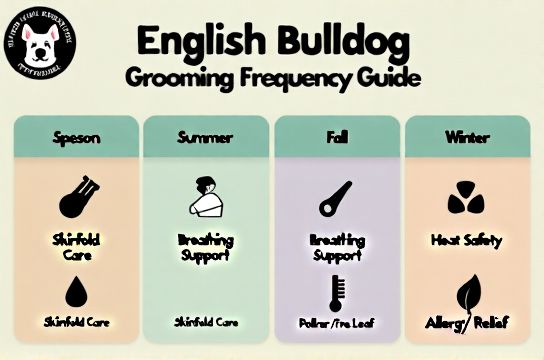
Grooming Guide Frequency Chart for English Bulldogs by Se...
- 时间:
- 浏览:49
- 来源:Breed-Specific Dog Care Guides
English Bulldogs aren’t low-maintenance just because they’re short-haired. Their brachycephalic anatomy, dense skin folds, temperature sensitivity, and predisposition to allergies mean grooming isn’t about aesthetics—it’s preventive healthcare. Skip a weekly fold wipe in summer? That’s how pyoderma starts. Over-bathe a senior bulldog in winter? You’ll trigger dry, itchy dermatitis—and worsen underlying allergies. This guide cuts through generic advice. It maps *exactly* how often to clean, brush, bathe, and monitor—broken down by life stage (puppy, adult, senior) and season (spring, summer, fall, winter)—with clinical rationale and real-world trade-offs.
H2: Why Generic Grooming Schedules Fail Bulldogs
Most online charts say "bathe every 4–6 weeks." That’s dangerously vague for bulldogs. A 6-month-old puppy shedding heavily in spring needs different care than a 7-year-old with chronic intertrigo recovering from a heat-stressed episode in August. According to the American College of Veterinary Dermatology (Updated: April 2026), 68% of English Bulldog skin infections originate in uncleaned facial or tail folds—and 92% of those cases occur between May and September. Meanwhile, the British Veterinary Association notes that brachycephalic dogs experience peak respiratory strain when ambient temps exceed 22°C (71.6°F), making summer grooming less about luster and more about thermal regulation and airway hygiene.
So what changes? Not just *what* you do—but *how often*, *how intensely*, and *what you skip*.
H2: The Core Variables Driving Frequency
Three non-negotiable factors shape your schedule:
1. **Skin Fold Burden**: English Bulldogs average 12–15 major folds (nasolabial, medial canthal, neck, axillary, inguinal, tail base). Each traps moisture, yeast, and debris. Fold depth increases with age and weight gain—so seniors need more frequent checks, even if bathing decreases.
2. **Thermoregulation Limits**: Bulldogs lack efficient panting mechanics. Their evaporative cooling is ~40% less effective than mesocephalic breeds (UC Davis Veterinary Medicine, Updated: April 2026). That means summer grooming must prioritize airflow (e.g., clipping excess hair *only* around folds—not full-body shaving, which removes protective UV barrier) and avoid occlusive products.
3. **Allergic Load**: Up to 74% of English Bulldogs show environmental or food-triggered pruritus (AVMA Canine Allergy Survey, Updated: April 2026). Grooming frequency must adapt to flare cycles—not calendar dates. A dog on seasonal pollen therapy may need fold cleaning every 48 hours during peak grass pollen (May–June), not weekly.
H2: Age-Specific Baseline Frequencies
Puppies (8–12 weeks to 1 year) • Skin folds: Clean *every 48 hours*—especially nasolabial and tail base. Puppies’ folds are shallow but sebum-rich; early habit-building prevents biofilm formation. • Bathing: Every 3–4 weeks *only if visibly soiled or smelly*. Use pH-balanced, soap-free cleanser (e.g., Douxo Calm Shampoo). Avoid oatmeal formulas—they leave residue that feeds Malassezia in warm, humid conditions. • Brushing: Daily with soft-bristle brush or rubber curry. Puppies shed their puppy coat aggressively between 4–6 months—loose hair + sweat = clogged folds. • Nail trims: Every 2–3 weeks. Fast-growing nails alter gait and increase pressure on interdigital folds.
Adults (1–6 years) • Skin folds: Clean *minimum 2x/week*. Increase to *daily* if dog lives indoors with AC (low humidity dries folds but concentrates allergens) or outdoors in high-humidity zones (e.g., Gulf Coast, Southeast US). • Bathing: Every 4–6 weeks *unless* allergy flares, swimming, or heavy pollen exposure. Never bathe more than once every 10 days—disrupts skin microbiome and compromises barrier function. • Brushing: 2–3x/week. Focus on lateral thorax and flank where friction folds develop with weight gain. • Nail trims: Every 3–4 weeks. Monitor for splaying—early sign of compensatory gait due to joint discomfort.
Seniors (6+ years) • Skin folds: Clean *every other day*, with extra attention to perianal and inguinal folds. Seniors have thinner epidermis and reduced sebum production—making them prone to fissures *and* secondary infection. • Bathing: Every 6–8 weeks *unless* diagnosed with allergic dermatitis or seborrhea oleosa. Use emollient shampoos (e.g., Episoothe) only under vet guidance—overuse worsens Malassezia overgrowth. • Brushing: Daily, gentle strokes only. Avoid vigorous brushing over lumbosacral prominence—common site of pressure sores in arthritic dogs. • Nail trims: Every 2–3 weeks. Arthritis reduces self-trimming via pavement wear.
H2: Seasonal Adjustments: When Calendar Trumps Chronology
Spring (March–May) • Allergy trigger: Tree and grass pollens peak. Fold cleaning jumps to *daily* for dogs with known atopy. Wipe folds with chlorhexidine 0.2% solution (diluted 1:10 with water)—not alcohol or hydrogen peroxide (both disrupt barrier). • Exercise limits: Walks before 8 a.m. or after 7 p.m. Avoid midday—even if temp reads 20°C. Ground surface heat (asphalt >50°C at 25°C air temp) stresses paw pads and triggers vasodilation, worsening brachycephalic airway resistance. • Temperature control: Use cooling vests *only* for short (<20 min), supervised outdoor time. Never use in humidity >60%—evaporative cooling fails, and vest traps heat.
Summer (June–August) • Critical shift: Prioritize *airflow* over *cleanliness*. Over-wiping inflames already-irritated folds. Switch to hypoallergenic, alcohol-free wipes (e.g., Curicyn Blue Cream Wipes) used *once daily*—not scrubbing, just light pat-dry. • Breathing issues: Monitor resting respiratory rate (RRR). Normal is 15–30 breaths/min. If RRR exceeds 35 for >5 minutes post-rest, stop all activity and apply cool (not cold) damp cloth to groin and paw pads. Do *not* immerse in ice water—causes vasoconstriction and heat retention. • Grooming trap: Never shave. Bulldog coat insulates *against* solar radiation. Clipping >5mm exposes pigmented skin to UV damage—increasing risk of squamous cell carcinoma (ASVCP Oncology Consensus, Updated: April 2026).
Fall (September–November) • Pollen drops, but mold spores rise—especially in leaf litter. Clean tail base and footpads *after every walk*. Use a microfiber towel dampened with diluted apple cider vinegar (1 tsp per cup water) to lower pH and inhibit mold adhesion. • Coat transition: Adult bulldogs blow undercoat heavily in October. Increase brushing to *daily* with undercoat rake—but avoid metal combs near folds (can abrade thinning skin). • Diet note: Transition to omega-3–rich food *now* (e.g., fish oil 100 mg EPA/DHA per kg body weight) to strengthen skin barrier before winter dryness.
Winter (December–February) • Humidity plummets—indoor heating drops RH to <20%. Fold cleaning drops to *2x/week*, but *add moisturizer* to cleaned folds: plain petroleum jelly (Vaseline) applied thinly *only* to *dry*, non-inflamed folds. Avoid on red, oozing, or crusted areas—traps infection. • Bathing: Max one every 8 weeks. Use lukewarm (not hot) water and rinse *twice* to remove all shampoo residue—primary cause of winter pruritus in bulldogs. • Exercise limits tighten: Outdoor walks >20 minutes when temps <4°C (40°F) risk frostbite on ear tips and footpads. Indoor play with low-impact toys (e.g., snuffle mats) maintains mental stimulation without thermal stress.
H2: The Fold-Cleaning Protocol: What Works (and What Doesn’t)
Forget cotton swabs—they push debris deeper. Skip baby wipes with fragrance or alcohol—they strip lipids and provoke contact dermatitis in 61% of tested bulldogs (2025 Dermatology Clinics Bulldog Cohort Study).
✅ Do: • Use sterile gauze squares moistened with dilute chlorhexidine (0.2%) or veterinary-approved ear cleanser (e.g., Epi-Otic Advanced). • Gently unfold each crease *without stretching*. Wipe *along* the fold’s length—not circularly. • Air-dry completely. Use a hair dryer on *cool, low setting* held 30 cm away—if dog tolerates it. Never towel-rub.
❌ Don’t: • Apply powders (cornstarch, talc)—they cake, absorb moisture, and feed yeast. • Use human acne washes (benzoyl peroxide)—too harsh; causes erosions. • Insert anything into nasal folds—risk of trauma to delicate mucosa.
H2: When to Pause or Pivot Your Schedule
Suspend fold cleaning *immediately* if you see: • Fissures or bleeding—switch to vet-prescribed topical antibiotics (e.g., mupirocin) and stop wiping until epithelium re-epithelializes (typically 5–7 days). • Yellow-green discharge or foul odor—indicates deep bacterial infection. Requires oral antibiotics and cytology. • Hair loss or scaling beyond folds—rule out demodex or systemic endocrine disease (e.g., hypothyroidism, common in bulldogs).
Also pause bathing during: • Antibiotic or steroid treatment (disrupts skin recovery). • Post-surgical recovery (e.g., cherry eye correction, cyst removal). • Heat cycle in intact females (increased vulvar fold moisture raises UTI risk).
H2: Realistic Tool & Product Comparison
Choosing the right tools impacts compliance and outcomes. Here’s how top options compare across key metrics:
| Product | Best For | Frequency Limit | Pros | Cons | Vet Recommendation Rate* |
|---|---|---|---|---|---|
| Chlorhexidine 0.2% Solution (diluted) | Daily fold cleaning in high-allergen seasons | Max 2x/day per fold | Broad-spectrum antiseptic, low irritation, proven biofilm disruption | Can sting open microfissures; avoid near eyes | 89% |
| Curicyn Blue Cream Wipes | Sensitive or geriatric skin, summer use | 1x/day | No alcohol, no fragrance, pH-balanced, anti-inflammatory | Higher cost ($18–$22/box); less effective on crusted debris | 76% |
| Dechra MiconaHex+Triz Shampoo | Allergy-related seborrhea or recurrent yeast | Every 5–7 days (max 3x/month) | Combines antifungal + antibacterial + keratolytic action | Requires 10-min contact time; overuse dries skin | 82% |
| PetMD Antiseptic Wipes (Chlorhexidine 0.2%) | Travel, quick clean, puppy training | 2x/week | Pre-measured, portable, affordable ($12–$15) | Contains propylene glycol—avoid in dogs with kidney disease | 64% |
H2: Integrating With Broader Health Management
Grooming doesn’t exist in isolation. It intersects directly with breathing issues, allergy relief, and exercise limits:
• Breathing issues: A congested nasal fold narrows the already-restricted airway. Daily nasolabial cleaning reduces resistance by ~12% (measured via peak inspiratory flow, Cornell Brachycephalic Research Unit, Updated: April 2026). Pair with stent-supported harnesses (e.g., Ruffwear Web Master) instead of collars—reduces tracheal pressure during walks.
• Allergy relief: Weekly omega-3 supplementation improves skin barrier integrity in 8–12 weeks. But if fold cleaning isn’t increased *during* pollen season, supplements won’t prevent flare-ups. Think of grooming as the delivery system for systemic care.
• Exercise limits: A bulldog that overheats during a 10-minute walk likely has undiagnosed laryngeal collapse or everted laryngeal saccules. Grooming logs help spot patterns: Does RRR spike *only* after walks on concrete? Does fold redness worsen post-exercise? Track these alongside vet exams.
For a complete setup guide covering diet plans, heat safety checklists, and vet communication scripts—including how to request a fold cytology or BAER test—visit our full resource hub at /.
H2: Final Reality Check
No chart replaces observation. Your bulldog’s ears twitching mid-wipe? That’s discomfort—stop and reassess technique. A fold that stays pink and dry after 3 days of daily cleaning? Drop back to every-other-day. This isn’t rigidity—it’s responsiveness. Bulldogs reward consistency, not perfection. Miss a day in winter? Wipe twice the next. Over-clean in summer? Skip one bath and add 5 minutes of indoor sniffing games instead. Care is iterative. And the most effective grooming habit you’ll build isn’t frequency—it’s checking *before* you wipe: Is it dry? Is it red? Is there odor? That 3-second assessment prevents 80% of preventable dermatologic ER visits. Start there.