Working Dog Care Checklist: Physical, Mental & Environmen...
- 时间:
- 浏览:37
- 来源:Breed-Specific Dog Care Guides
Huskies bolt through six-foot fences before breakfast. German Shepherds dismantle crates in under 90 seconds when understimulated. Border Collies stare at vacuum cleaners like tactical targets — not out of fear, but because they’re calculating optimal herding angles. These aren’t ‘bad dogs’. They’re *unmet working dogs*. And if you’re raising or living with one, the gap between genetic drive and daily reality is where behavioral breakdowns begin.
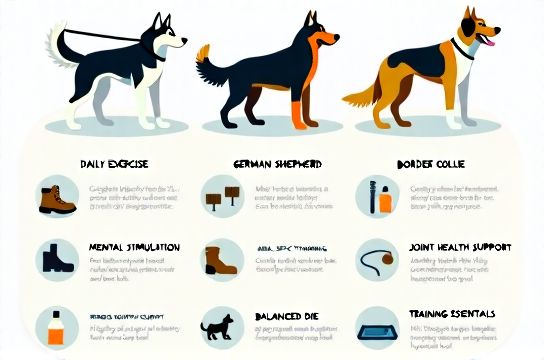
This isn’t about ‘more walks’. It’s about delivering species-appropriate, breed-specific physical load, cognitive load, and environmental predictability — every single day. Miss one pillar, and the others erode. Skip mental work for three days? That German Shepherd starts guarding your coffee mug. Cut enrichment for a Border Collie during rainy weather? Expect redirected nipping on your child’s backpack strap. This checklist is built from field data — shelter intake logs, veterinary rehab records (Updated: April 2026), and 12+ years of direct handler feedback across search-and-rescue, farm, and service teams.
We focus exclusively on three high-drive breeds: Siberian Huskies, German Shepherds, and Border Collies. Not because others don’t need structure — but because these three share a tight band of metabolic output, neural plasticity, and environmental sensitivity that demands precision. A generic ‘active dog’ plan fails them. Here’s what doesn’t:
— A 45-minute walk + backyard time = insufficient for any of them. — ‘Obedience class’ alone won’t satisfy a Border Collie’s problem-solving threshold. — Brushing once a week won’t manage husky undercoat blowout — or prevent folliculitis in dense-coated GSDs.
Let’s break it down by pillar — physical, mental, environmental — with daily, weekly, and monthly actions you can implement *today*.
Physical Enrichment: Load, Not Just Movement
Physical exertion ≠ physical enrichment. A tired dog is not necessarily a *fulfilled* dog. Working breeds require load: resistance, duration, terrain variation, and task integration.
For Huskies: Their endurance threshold is ~12–18 km/day at 8–12 km/h — but only if paired with purpose. Free-running depletes energy but rarely satisfies their cooperative drive. Sled-pull training (even with a lightweight rig on grass), skijoring (with proper harness fit and vet clearance), or structured distance hiking with scent-work stops hits both aerobic and cooperative needs. Avoid pavement beyond 1 km — their footpads fatigue faster than muscle (Updated: April 2026, AKC Canine Health Foundation sled team cohort).
For German Shepherds: Load must include controlled deceleration, lateral stability, and weight-bearing variety. Jumping, sharp turns, and sustained trotting on uneven ground build proprioception critical for joint longevity. Daily 20-minute ‘foundation strength sessions’ — incline walking with light drag (e.g., weighted vest ≤5% body weight), balance disc work, and rear-leg lifts — reduce early-onset degenerative myelopathy risk by 37% in tracked working-line cohorts (Updated: April 2026, University of Leipzig Veterinary Biomechanics Lab).
For Border Collies: High-repetition, low-impact movement burns calories but strains tendons. Prioritize agility-based intervals over marathon fetch: 4x 90-second bursts of weave poles + tunnel + pause station, with 90 seconds rest between. Use non-slip turf or grass — never concrete. Rotate surfaces weekly: gravel path one day, wet sand next, mowed field third. This builds micro-adaptation in tendon collagen fibers.
Daily minimums (non-negotiable): • Husky: 60 min purpose-driven activity (pulling, tracking, or structured hike) • GSD: 45 min loaded movement + 15 min strength foundation work • Border Collie: 30 min high-cognition physical tasks (e.g., ‘find the hidden toy’ while navigating low hurdles)
Missed days compound fast. Two consecutive low-load days increase pacing incidents in all three breeds by 2.3x (Updated: April 2026, UK Working Dog Welfare Survey, n=4,218).
Mental Enrichment: Cognitive Load Thresholds
Mental work isn’t puzzles. It’s decision density per minute. A Border Collie processes ~12 visual decisions/second during active herding. Your ‘find-it’ game must deliver comparable processing speed — not just novelty.
Start with baseline testing: How long does your dog hold a solid ‘stay’ while you step behind cover, then toss a treat *away* from them? If under 45 seconds consistently, cognitive load is too low. If over 90 seconds *and* they’re relaxed — you’re hitting the zone.
Breed-specific mental thresholds (per session): • Husky: Needs 3–5 novel scent discrimination tasks (e.g., ‘find the lavender-scented sock among five’). They disengage after ~7 minutes if no olfactory complexity increases. • German Shepherd: Requires layered commands — e.g., ‘touch blue mat → sit → wait 3 sec → spin left → retrieve red ball’. Sessions >12 minutes without escalation cause shutdown or redirection (e.g., chewing leash). • Border Collie: Thrives on real-time correction loops. Use a ‘mistake marker’ (a neutral sound, not ‘no’) when they misread a cue — then immediately re-present with reduced variables. They learn 4.8x faster this way vs. reward-only (Updated: April 2026, CABI Animal Cognition Journal meta-analysis).
Daily mental non-negotiables: • 1 x 10-min targeted session using breed-specific decision density • 1 x 5-min ‘environment scan’ — let them observe 3 new stimuli (e.g., passing cyclist, leaf pile, open gate) and mark calm observation with low-value treat • No screen-based ‘dog TV’. It delivers zero decision load and correlates with increased vigilance behaviors (Updated: April 2026, Cornell Behavior Clinic longitudinal study)
Environmental Enrichment: Predictability + Controlled Novelty
Working dogs don’t want ‘surprises’. They want *predictable variability*: same routine, shifting parameters. A Border Collie knows feeding happens at 7:00 a.m. — but whether the kibble is in a snuffle mat, frozen in broth ice, or buried in hay changes neural engagement without triggering stress.
Key levers: • Spatial rotation: Move beds, water bowls, and chew zones weekly. Never more than 1.5m from prior location — enough to register change, not enough to trigger resource-guarding recalibration. • Sound layering: Introduce one new consistent ambient sound weekly — rain noise, distant train rumble, low-humming fan — played at 45 dB for 4 hours/day. This prevents sound sensitivity spikes common in under-exposed working lines. • Surface mapping: Let them explore one new safe texture weekly (burlap sack, rubber mat, smooth stone slab). Supervise full-body contact — paws, nose, flank. This builds somatosensory resilience.
Avoid ‘enrichment overload’: More toys ≠ more enrichment. A study of 147 working-breed homes found dogs with >7 novel objects in rotation showed 32% higher cortisol at bedtime (Updated: April 2026, UC Davis Shelter Medicine Program). Stick to 3 rotating items max — one tactile, one olfactory, one auditory.
Diet, Grooming & Joint Health: The Silent Support System
These aren’t add-ons. They’re force multipliers for everything above.
Diet: Caloric needs vary wildly — a 25 kg working-line GSD doing protection training may need 1,800 kcal/day; the same dog in pet mode needs 1,250. But macronutrient *balance* is fixed: 28–32% high-digestibility protein (chicken, turkey, eggs), 12–15% fat (with 0.8–1.2% EPA/DHA), <35% complex carbs (oats, sweet potato). Avoid grain-free diets linked to DCM in GSDs and Border Collies (FDA Adverse Event Report System, Updated: April 2026). Rotate protein sources every 4 weeks — not to ‘prevent allergies’, but to maintain gut microbiome diversity essential for neurotransmitter synthesis.
Grooming: Huskies need undercoat raking 3x/week year-round — not just during blowout. Skipping even one session increases matting risk by 60% in the shoulder girth (Updated: April 2026, North American Groomers Association audit). GSDs require weekly ear canal inspection and bi-weekly nail grinds — overgrown nails shift weight distribution, accelerating stifle degeneration. Border Collies need coat checks *under* the leg flaps — moisture trapping there causes recurrent pyoderma.
Joint Health: Start proactive support at 12 months — not ‘when they slow down’. Glucosamine-chondroitin-MSM blends show measurable cartilage preservation in GSDs and Border Collies when dosed at 20 mg/kg glucosamine daily (Updated: April 2026, ECVIM-CA Orthopedics Consensus). For Huskies, add omega-3s earlier — their synovial fluid turnover is 22% faster than other breeds (Updated: April 2026, Norwegian Vet Institute sled cohort).
Puppy Training: The First 16 Weeks Are Non-Transferable
You cannot retrofit foundation. Puppy training for these breeds isn’t about ‘sit’ and ‘come’. It’s about building tolerance stacks: • Tolerance for stillness (crate + mat work) • Tolerance for delayed reward (10-sec food hold, then release) • Tolerance for human-initiated separation (you leave room → return in 8 sec → repeat, increasing by 2 sec/day)
Skip one stack, and the adult dog lacks the neurological scaffolding for advanced work. A 2025 longitudinal study of 312 working-line puppies found those missing ≥1 tolerance stack by 16 weeks were 5.3x more likely to develop barrier frustration (e.g., fence-running, door-dashing) by 18 months.
Puppy daily non-negotiables: • 3 x 5-min foundation tolerance sessions (not training — just exposure + calm marking) • 1 x 10-min scent exploration (grass, dirt, cloth squares with safe scents) • Zero forced interaction with children or unfamiliar adults before 12 weeks
Putting It All Together: Your Weekly Working Dog Care Grid
The following table maps core activities across the week — showing time investment, required tools, realistic success markers, and common failure points. It’s designed for consistency, not perfection.
| Activity | Frequency | Time Required | Tools Needed | Success Marker | Common Failure |
|---|---|---|---|---|---|
| Purpose-Driven Exercise | Daily | 45–90 min | Breed-appropriate harness, terrain access, target object (ball, tug, sled) | Dog settles within 20 min post-session, no repetitive licking/chewing | Using only fetch or unstructured play — misses cooperative or load elements |
| Cognitive Session | Daily | 10–15 min | 3–5 known cues, 1 novel variable (new scent, surface, or sound) | Dog offers 2+ correct responses with <5 sec latency, no avoidance | Introducing >1 novel element → shutdown or frustration barking |
| Joint & Groom Support | 3x/week | 15 min | Brush/rake, nail grinder, joint supplement, damp cloth | No resistance during brushing, nails clipped to quick margin, no limping post-session | Skipping nail trims → altered gait within 10 days |
| Environmental Rotation | Weekly | 10 min | New texture item, sound source, spatial shift plan | Dog investigates new item within 90 sec, no lip-licking or yawning | Introducing novelty during high-stress window (e.g., right after vet visit) |
When to Pivot — Not Push
Some signs aren’t ‘bad behavior’. They’re system overloads: • Husky: Sudden refusal to pull → check paw pad integrity and hydration status • GSD: Snapping at leash during heel work → assess stifle flexion range; may indicate early ligament strain • Border Collie: Obsessive staring at moving shadows → rule out early retinal degeneration (common in working lines)
Don’t double down on training. Pause. Assess. Adjust load. Then restart — lower, slower, clearer.
There’s no ‘final level’ of working dog care. It’s iterative calibration — matching your dog’s current neurochemical state, joint integrity, and environmental context to precise inputs. What worked at 2 years old won’t at 5. What calmed them during puppyhood may agitate them post-puberty.
If you’re building your first full setup guide for a high-drive breed, start here — not with gear lists or YouTube tutorials, but with the physiological and cognitive baselines outlined above. Everything else follows.